


Page 259 - EJMO-9-1
P. 259
Eurasian Journal of
            Medicine and Oncology                              Quality of life, somatosensory amplification, and stress in ADPKD


            Table 3. Correlation results of PKD group and healthy group
            All participants (n=98)           HRQOL                       PSS                        SSAS
            Duration of disease            r=0.148, p=0.162          r=−0.321, p=0.032*          r=0.255, p=0.014*
            HRQOL                               1                     r=0.438, p=0.622**         r=0.408, p=0.182**
            PSS                                                            1                     r=0.638, p=0.107
            SSAS                                                                                      1
            PKD patients (n=50)               HRQOL                       PSS                        SSAS
            Duration of disease            r=−0.102, p=0.364         r=−0.298, p=0.013*          r=0.864, p=0.152
            HRQOL                               1                     r=0.122, p=0.680**         r=0.286, p=0.038*
            PSS                                                            1                     r=0.692, p=0.001**
            SSAS                                                                                      1
            Notes: **Correlation is significant at p<0.01; *correlation is significant at p<0.05.
            Abbreviations: HRQOL: Health-related quality of life; PKD: Polycystic kidney disease; PSS: Perceived Stress Scale; SSAS: Somatosensory amplification
            scale.

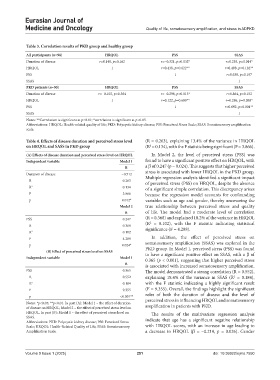
            Table 4. Effects of disease duration and perceived stress level   (R = 0.263), explaining 13.4% of the variance in HRQOL
            on HRQOL and SASS in PKD group                     (R  = 0.134), with the F statistic being significant (F = 3.866).
                                                                 2
            (A) Effects of disease duration and perceived stress level on HRQOL  In Model 2, the level of perceived stress (PSS) was
            Independent variable                    Model 1    found to have a significant positive effect on HRQOL, with
                                                      Β        a β of 0.247 (p = 0.024). This suggests that higher perceived
            Duration of disease                      −0.512    stress is associated with lower HRQOL in the PKD group.
                                                               Multiple regression analysis identified a significant impact
             R                                       0.263     of perceived stress (PSS) on HRQOL, despite the absence
             R 2                                     0.134     of a significant simple correlation. This discrepancy arises
             F                                       3.866     because the regression model accounts for confounding
             p                                       0.012*    variables such as age and gender, thereby uncovering the
                                                    Model 2    true  relationship between perceived stress and quality
                                                      Β        of life. The model had a moderate level of correlation
            PSS                                      0.247     (R = 0.368) and explained 10.2% of the variance in HRQOL
                                                                 2
             R                                       0.368     (R  = 0.102), with the F statistic indicating statistical
                                                               significance (F = 4.288).
             R 2                                     0.102
             F                                       4.288       In  addition,  the  effect  of  perceived  stress  on
             p                                       0.024*    somatosensory amplification (SSAS) was explored in the
                     (B) Effect of perceived stress level on SSAS  PKD group. In Model 1, perceived stress (PSS) was found
                                                               to have a significant positive effect on SSAS, with a β of
            Independent variable                    Model 1    0.365 (p < 0.001), suggesting that higher perceived stress
                                                      Β        is associated with increased somatosensory amplification.
            PSS                                      0.365     The model demonstrated a strong correlation (R = 0.552),
             R                                       0.552     explaining 18.4% of the variance in SSAS (R  = 0.184),
                                                                                                    2
             R 2                                     0.184     with the F statistic indicating a highly significant result
             F                                       9.355     (F = 9.355). Overall, the findings highlight the significant
             p                                      <0.001**   roles of both the duration of disease and the level of
            Notes: *p<0.05; **p<0.01. In part (A): Model 1 – the effect of duration   perceived stress in influencing HRQOL and somatosensory
            of disease on HRQOL; Model 2 – the effect of perceived stress level on   amplification in patients with PKD.
            HRQOL. In part (B): Model 1 – the effect of perceived stress level on   The results of the multivariate regression analysis
            SSAS.                                              indicate that age has a significant negative relationship
            Abbreviations: PKD: Polycystic kidney disease; PSS: Perceived Stress
            Scale; HRQOL: Health-Related Quality of Life; SSAS: Somatosensory   with HRQOL scores, with an increase in age leading to
            Amplification Scale.                               a decrease in HRQOL (β = −0.210,  p = 0.026). Gender


            Volume 9 Issue 1 (2025)                        251                              doi: 10.36922/ejmo.7550

