


Page 29 - EJMO-9-1
P. 29
Eurasian Journal of Medicine and
            Oncology
                                                                              BRCA VUS in breast cancer in MENA region


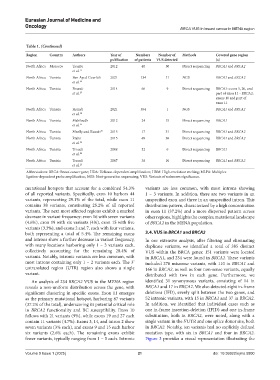
            Table 1. (Continued)
            Region    Country   Authors         Year of    Numbers   Number of   Methods     Covered gene region
                                                publication  of patients  VUS detected       (s)
            North Africa  Morocco  Taazite      2012         40        50      Direct sequencing  BRCA1 and BRCA2
                                et al.
                                    15
            North Africa  Tunisia  Ben Ayed-Guerfali   2021  134       11      NGS           BRCA1 and BRCA2
                                et al.  29
            North Africa  Tunisia  Fourati      2014         66         9      Direct sequencing  BRCA1: exons 5, 20, and
                                et al.  27                                                   part of exon 11 - BRCA2:
                                                                                             exons 10 and part of
                                                                                             exon 11
            North Africa  Tunisia  Hamdi        2021         354        1      NGS           BRCA1 and BRCA2
                                et al.  30
            North Africa  Tunisia  Mahfoudh     2012         24        15      Direct sequencing  BRCA1
                                et al.  25
            North Africa  Tunisia  Msolly and Kassab 28  2015  17      31      Direct sequencing  BRCA1 and BRCA2
            North Africa  Tunisia  Riahi        2015         48        38      Direct sequencing  BRCA1 and BRCA2
                                et al.  26
            North Africa  Tunisia  Troudi       2008         32         6      Direct sequencing  BRCA1
                                et al.  24
            North Africa  Tunisia  Troudi       2007         36        10      Direct sequencing  BRCA1 and BRCA2
                                et al.  23
            Abbreviations: BRCA: Breast cancer gene; HDA: Helicase-dependent amplification; HRM: High-resolution melting; MLPA: Multiplex
            ligation-dependent probe amplification; NGS: Next-generation sequencing; VUS: Variants of unknown significance.

            mutational hotspots that account for a combined 54.3%   variants are less common, with most introns showing
            of all reported variants. Specifically, exon 10 harbors 44   1 – 3 variants. In addition, there are two variants in an
            variants, representing 29.1% of the total, while exon 11   unspecified exon and three in an unspecified intron. This
            contains 38 variants, constituting 25.2% of all reported   distribution pattern, characterized by a high concentration
            variants. The next most affected regions exhibit a marked   in exon 11 (37.2%) and a more dispersed pattern across
            decrease in variant frequency: exon 16 with seven variants   other regions, highlights the complex mutational landscape
            (4.6%), exon 19 with six variants (4%), exon 15 with five   of BRCA2 in the MENA population.
            variants (3.3%), and exons 2 and 7, each with four variants,
            both representing a total of 5.4%. The remaining exons   3.4. VUS in BRCA1 and BRCA2
            and introns show a further decrease in variant frequency,   In our extensive analysis, after filtering and eliminating
            with many locations harboring only 1 – 3 variants each,   duplicate variants, we identified a total of 385 distinct
            collectively accounting for the remaining 28.4% of   VUS within the BRCA genes: 151 variants were located
            variants. Notably, intronic variants are less common, with   in BRCA1, and 234 were found in BRCA2. These variants
            most introns containing only 1 – 2 variants each. The 3’   included 276 missense variants, with 110 in BRCA1 and
            untranslated region (UTR) region also shows a single   166 in BRCA2, as well as four non-sense variants, equally
            variant.                                           distributed with two in each gene. Furthermore, we
              An analysis of 234 BRCA2 VUS in the MENA region   identified 31 synonymous variants, consisting of 14 in
            reveals a non-uniform distribution across the gene, with   BRCA1 and 17 in BRCA2. We also detected eight in-frame
            significant clustering in specific exons. Exon 11 emerges   deletions (IFD), evenly split between the two genes, and
            as the primary mutational hotspot, harboring 87 variants   52 intronic variants, with 15 in BRCA1 and 37 in BRCA2.
            (37.2% of the total), underscoring its potential critical role   In  addition,  we identified  that  individual  cases  such  as
            in  BRCA2 functionality and BC susceptibility. Exon 10   one in-frame insertion-deletion (IFID) and one in-frame
            follows with 21 variants (9%), while exons 19 and 27 each   substitution, both in  BRCA2, were noted, along with a
            contain 11 variants (4.7%). Exons 3, 14, and intron 2 show   single variant in the 5’UTR and one splice donor site, both
            seven variants (3% each), and exons 9 and 15 each harbor   in BRCA2. Notably, ten variants had no explicitly defined
            six  variants  (2.6%  each).  The  remaining  exons  exhibit   mutation  type, with six in  BRCA1 and four in  BRCA2.
            fewer variants, typically ranging from 1 – 5 each. Intronic   Figure 3 provides a visual representation illustrating the


            Volume 9 Issue 1 (2025)                         21                              doi: 10.36922/ejmo.5800

