


Page 121 - EJMO-9-2
P. 121
Eurasian Journal of
            Medicine and Oncology                                                      Understanding ulcerative colitis


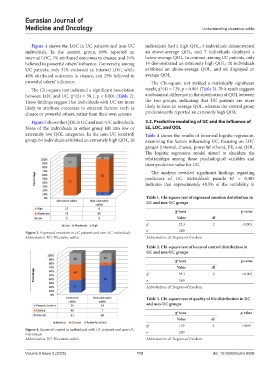
              Figure 4 shows the LOC in UC patients and non-UC   individuals had a high QOL, 9 individuals demonstrated
            individuals.  In  the  control  group,  69%  reported  an   an above-average QOL, and 7 individuals displayed a
            internal LOC, 7% attributed outcomes to chance, and 24%   below-average QOL. In contrast, among UC patients, only
            believed in powerful others’ influence. Conversely, among   14 demonstrated an extremely high QOL; 20 individuals
            UC patients, only 31% endorsed an internal LOC, while   exhibited an above-average QOL, and 66 displayed an
            40% attributed outcomes to chance, and 29% believed in   average QOL.
            powerful others’ influence.                          The Chi-square test yielded a statistically significant
                                                                     2
              The Chi-square test indicated a significant association   result, χ (4) = 129, p < 0.001 (Table 3). This result suggests
            between LOC and UC, χ (2) = 38.1, p < 0.001 (Table 2).   a substantial difference in the distribution of QOL between
                                2
            These findings suggest that individuals with UC are more   the two groups, indicating that UC patients are more
            likely  to  attribute  outcomes  to  external factors, such as   likely to have an average QOL, whereas the control group
            chance or powerful others, rather than their own actions.  predominantly reported an extremely high QOL.

              Figure 5 shows the QOL in UC and non-UC individuals.   3.2. Predictive modeling of UC and the influence of
            None of the individuals in either group fell into low or   EE, LOC, and QOL
            extremely low QOL categories. In the non-UC (control)   Table 4 shows the results of binomial logistic regression,
            group, 64 individuals exhibited an extremely high QOL, 20   examining the factors influencing UC, focusing on LOC
                                                               groups (internal, chance, powerful others), EE, and QOL.
                                                               The logistic regression model aimed to elucidate the
                                                               relationships  among  these  psychological  variables  and
                                                               their predictive value for UC.
                                                                 The  analysis  revealed  significant  findings  regarding
                                                               predictors of UC. McFadden’s pseudo R  = 0.485
                                                                                                    2
                                                               indicates that approximately 48.5% of the variability in

                                                               Table 1. Chi‑square test of expressed emotion distribution in
                                                               UC and non‑UC groups

                                                                            χ  tests                   p‑value
                                                                            2
                                                                            Value          df
                                                               χ 2           23.3           2           <0.001
            Figure 3. Expressed emotions in UC patients and non-UC individuals  n  200
            Abbreviation: UC: Ulcerative colitis.              Abbreviation: df: Degrees of freedom.

                                                               Table 2. Chi‑square test of locus of control distribution in
                                                               UC and non‑UC groups

                                                                            χ  tests                   p‑value
                                                                            2
                                                                            Value          df
                                                               χ 2           38.1           2           <0.001
                                                               n             200
                                                               Abbreviation: df: Degrees of freedom.

                                                               Table 3. Chi‑square test of quality of life distribution in UC
                                                               and non‑UC groups
                                                                            χ  tests                   p‑value
                                                                            2
                                                                            Value          df
                                                               χ 2           129           4            <0.001
            Figure 4. Locus of control in individuals with UC patients and non-UC
            individuals                                        n             200
            Abbreviation: UC: Ulcerative colitis.              Abbreviation: df: Degrees of freedom.


            Volume 9 Issue 2 (2025)                        113                              doi: 10.36922/ejmo.8596

