


Page 122 - EJMO-9-2
P. 122
Eurasian Journal of
            Medicine and Oncology                                                      Understanding ulcerative colitis


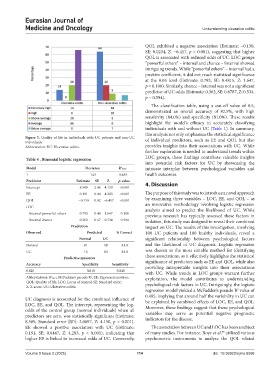
                                                               QOL exhibited a negative association (Estimate: −0.150,
                                                               SE: 0.0234, Z: −6.417, p < 0.001), suggesting that higher
                                                               QOL is associated with reduced odds of UC. LOC groups
                                                               “powerful others” – internal and chance – Internal showed
                                                               intriguing trends. While “powerful others” – internal had a
                                                               positive coefficient, it did not reach statistical significance
                                                               at the 0.05 level (Estimate: 0.793, SE: 0.4815, Z: 1.647,
                                                               p = 0.100). Similarly, chance – internal was not a significant
                                                               predictor of UC odds (Estimate: 0.362, SE: 0.6787, Z: 0.534,
                                                               p = 0.594).
                                                                 The classification table, using a cut-off value of 0.5,
                                                               demonstrated an overall accuracy of 82.5%,  with high
                                                               sensitivity (84.0%) and specificity (81.0%). These results
                                                               highlight the model’s  efficacy in  accurately classifying
                                                               individuals with and without UC (Table 1). In summary,
                                                               this analysis not only emphasizes the statistical significance
            Figure 5. Quality of life in individuals with UC patients and non-UC   of individual predictors, such as EE  and QOL but also
            individuals
            Abbreviation: UC: Ulcerative colitis.              provides insights into their associations with UC. While
                                                               further exploration is needed to understand trends within

            Table 4 . Binomial logistic regression             LOC groups, these findings contribute valuable insights
                                                               into  potential risk factors  for UC  by showcasing  the
            Model                    Deviance      R MCF       intricate interplay between psychological variables and
                                                    2
            1                           143         0.485      health outcomes.
            Predictor             Estimate  SE  Z  p‑value     4. Discussion
            Intercept              8.589  2.06  4.150  <0.001
            EE                     0.191  0.04  4.283  <0.001  The purpose of this study was to introduce a novel approach
                                                               by examining three variables – LOC, EE, and QOL – as
            QOL                   −0.150  0.02 −6.417  <0.001
            LOC                                                an innovative methodology involving logistic regression
                                                               analysis aimed to predict the likelihood of UC. While
             Internal-powerful others  0.793  0.48  1.647  0.100  previous research has typically assessed these factors in
             Internal chance       0.362  0.67  0.534  0.594   isolation, this study was designed to reveal their combined
                               Prediction                      impact on UC. The results of this investigation, involving
            Observed                  Predicted    % Correct   100 UC patients and 100 healthy individuals, reveal a
                                   Normal    UC                significant relationship between psychological factors
            Normal                   81      19      81.0      and the likelihood of UC diagnosis. Logistic regression
            UC                       16      84      84.0      was chosen as the most suitable method for identifying
                            Predictive measures                these associations, as it effectively highlights the statistical
            Accuracy                Specificity  Sensitivity   significance of predictors such as EE and QOL, while also
                                                               providing interpretable insights into their associations
            0.825                     0.810        0.840       with UC. While trends in LOC groups warrant further
            Abbreviations: R MCF: McFadden’s pseudo R , EE: Expressed emotion;   exploration, the model contributes to understanding
                       2
                                        2
            QOL: Quality of life; LOC: Locus of control; SE: Standard error;    psychological risk factors in UC. Intriguingly, the logistic
            Z: Z-score, UC: Ulcerative colitis.
                                                               regression model yielded a McFadden’s pseudo R  value of
                                                                                                      2
                                                               0.485, implying that around half the variability in UC can
            UC diagnosis is accounted for the combined influence of   be explained by combined effects of LOC, EE, and QOL.
            LOC, EE, and QOL. The intercept, representing the log-  Moreover, these findings suggest that these psychological
            odds of the control group (normal individuals) when all   variables may serve as potential negative prognostic
            predictors are zero, was statistically significant (Estimate:   indicators for the disease.
            8.589, Standard error [SE]: 2.0697, Z: 4.150,  p < 0.001).
            EE showed a positive association with UC (Estimate:   The association between UC and LOC has been a subject
            0.191, SE: 0.0447, Z: 4.283,  p < 0.001), indicating that   of many studies. For instance, Boye et al.  utilized various
                                                                                               35
            higher EE is linked to increased odds of UC. Conversely,   psychometric instruments to analyze the QOL related

            Volume 9 Issue 2 (2025)                        114                              doi: 10.36922/ejmo.8596

