


Page 98 - EJMO-9-2
P. 98
Eurasian Journal of Medicine and
            Oncology
                                                       Dietary links between dairy, meat, and egg intake and pancreatic cancer risk


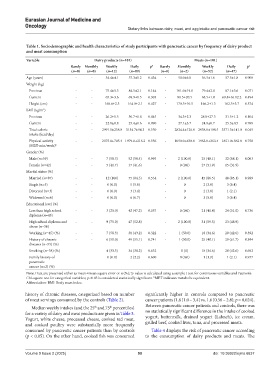
            Table 1. Sociodemographic and health characteristics of study participants with pancreatic cancer by frequency of dairy product
            and meat consumption
            Variable                     Dairy products (n=101)                     Meats (n=101)
                               Rarely  Monthly  Weekly  Daily    p*  Rarely  Monthly   Weekly     Daily   p a
                               (n=0)  (n=0)   (n=12)    (n=89)       (n=0)    (n=2)    (n=52)    (n=47)
            Age (years)          -      -     54.4±4.1  57.3±1.2  0.434  -   58.0±6.0  56.5±1.6  57.5±1.8  0.908
            Weight (kg)
             Previous            -      -     75.4±5.3  84.5±2.1  0.144  -  101.0±19.0  79.4±2.0  87.1±3.6  0.071
             Current             -      -     65.3±3.6  69.9±1.5  0.303  -  80.5±20.5  68.5±1.8  69.8±16.12.2 0.494
             Height (cm)         -      -     168.6±2.3  164.0±2.1  0.427  -  170.5±10.5  166.2±1.3  162.5±3.7  0.574
                   2
            BMI (kg/m )
             Previous            -      -     26.2±1.5  30.7±0.8  0.045  -   34.3±2.3  28.8±27.3  31.5±1.2  0.104
             Current             -      -     22.8±0.8  25.4±0.6  0.090  -   27.1±3.7  24.9±0.7  25.3±0.5  0.789
             Total caloric       -      -   2991.1±258.8  3154.7±94.3  0.550  -  2824.4±126.0 2938.0±108.5 3371.3±141.0 0.045
             intake (kcal/day)
             Physical activity   -      -   2375.0±705.4 1979.0±216.2 0.556  -  1050.0±630.0 1965.0±263.4 1851.0±362.8 0.758
             (MET-min/week) b
            Gender (%)
             Male (n=59)         -      -     7 (58.3)  52 (58.4)  0.995  -  2 (100.0)  25 (48.1)  32 (68.1)  0.063
             Female (n=42)       -      -     5 (41.7)  37 (41.6)      -      0 (0.0)  27 (51.9)  15 (31.9)
            Marital status (%)
             Married (n=87)      -      -     12 (100)  75 (84.3)  0.534  -  2 (100.0)  45 (86.5)  40 (85.1)  0.989
             Single (n=5)        -      -      0 (0.0)  5 (5.6)        -       0        2 (3.8)   3 (6.4)
             Divorced (n=3)      -      -      0 (0.0)  3 (3.4)        -       0        2 (3.8)   1 (2.1)
             Widowed (n=6)       -      -      0 (0.0)  6 (6.7)        -       0        3 (5.8)   3 (6.4)
            Educational level (%)
             Less than high school   -  -     3 (25.0)  42 (47.2)  0.057  -   0 (0.0)  21 (40.4)  24 (51.0)  0.736
             diploma (n=45)
             High school diploma and   -  -   9 (75.0)  47 (52.8)      -     2 (100.0)  31 (59.5)  23 (48.9)
             above (n=56)
             Working (n=45) (%)  -      -     7 (58.3)  38 (43.2)  0.322  -  1 (50.0)  18 (34.6)  20 (42.6)  0.392
             History of chronic   -     -     6 (50.0)  49 (55.1)  0.741  -  1 (50.0)  25 (48.1)  29 (61.7)  0.394
             diseases (n=55) (%)
             Smoking (n=38) (%)  -      -     4 (33.3)  34 (38.2)  0.632  -   0 (0)    18 (34.6)  20 (42.6)  0.692
             Family history of   -      -      0 (0.0)  2 (2.2)  0.600  -     0 (0.0)   1 (1.9)   1 (2.1)  0.977
             pancreatic
             cancer (n=2) (%)
            Note: Data are presented either as mean±mean square error or n (%);  p-value is calculated using a sample t-test for continuous variables and Pearson’s
                                                         a
            Chi-square test for categorical variables; p<0.05 is considered statistically significant.  MET indicates metabolic equivalent.
                                                                  b
            Abbreviation: BMI: Body mass index.
            history of chronic diseases, categorized based on number   significantly higher in controls compared to pancreatic
            of meat servings consumed by the controls (Table 2).  cancer patients (1.8 [1.0 – 3.4] vs. 1.6 [0.56 – 2.8]; p = 0.024).
                                         th
                                                th
              Median weekly intakes (and the 25  and 75  percentiles)   Between pancreatic cancer patients and controls, there was
            for a variety of dairy and meat products are given in Table 3.   no statistically significant difference in the intake of cooked
            Yogurt, white cheese, processed cheese, cooked red meat,   yogurt, buttermilk, drained yogurt (Labneh), ice cream,
            and cooked poultry were substantially more frequently   grilled beef, cooked liver, tuna, and processed meats.
            consumed by pancreatic cancer patients than by controls   Table 4 displays the risk of pancreatic cancer according
            (p < 0.05). On the other hand, cooked fish was consumed   to the consumption of dairy products and meats. The


            Volume 9 Issue 2 (2025)                         90                              doi: 10.36922/ejmo.6637

