


Page 236 - EJMO-9-3
P. 236
Eurasian Journal of
            Medicine and Oncology                                                 ICU pharmacists and clinical outcomes


            ventilator days, cost-related implications, and the broader   CCPs; C (Comparison): care without CCPs; O (Outcomes):
            clinical roles of CCPs such as antimicrobial stewardship,   mortality and ADEs; S (Study Design): randomized
            pharmacotherapy optimization, and interdisciplinary   controlled trials, prospective cohort studies, and retrospective
            care contributions. This comprehensive approach aims to   observational studies.  A comprehensive and systematic
                                                                                21
            inform evidence-based policy and practice regarding the   literature search was performed across three major electronic
            integration of pharmacists into critical care teams.  databases: PubMed, Embase, and the Cochrane Library. The
                                                               search  spanned  from  database  inception  through  January
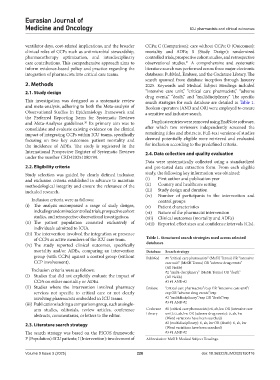
            2. Methods                                         2025.  Keywords  and Medical  Subject  Headings  included

            2.1. Study design                                  “intensive care  unit,”  “critical care pharmacists,” “adverse
                                                               drug events,” “death,” and “multidisciplinary.” The specific
            This investigation was designed as a systematic review   search strategies for each database are detailed in Table 1.
            and meta-analysis, adhering to both the Meta-analysis of   Boolean operators (AND and OR) were employed to ensure
            Observational Studies in Epidemiology framework and   a sensitive and inclusive search.
            the Preferred Reporting Items for Systematic Reviews
            and Meta-Analyses guidelines.  Its primary aim was to   Duplicate entries were removed using EndNote software,
                                     20
            consolidate and evaluate existing evidence on the clinical   after which two reviewers independently screened the
            impact of integrating CCPs within ICU teams, specifically   remaining titles and abstracts. Full-text versions of studies
            focusing  on  two  key  outcomes:  patient  mortality  and   deemed potentially eligible were retrieved and evaluated
            the incidence of ADEs. The study is registered in the   for inclusion according to the predefined criteria.
            International Prospective Register of Systematic Reviews   2.4. Data collection and quality evaluation
            under the number CRD420251080799.
                                                               Data were systematically collected using a standardized
            2.2. Eligibility criteria                          and pre-tested data extraction form. From each eligible
            Study selection was guided by clearly defined inclusion   study, the following key information was obtained:
            and exclusion criteria established in advance to maintain   (i)   First author and publication year
            methodological integrity and ensure the relevance of the   (ii)   Country and healthcare setting
            included research.                                 (iii)  Study design and duration
                                                               (iv)   Number of participants in the intervention and
              Inclusion criteria were as follows:                   control groups
            (i)  The analysis encompassed a range of study designs,   (v)   Patient characteristics
               including randomized controlled trials, prospective cohort   (vi)   Nature of the pharmacist intervention
               studies, and retrospective observational investigations.  (vii)  Clinical outcomes (mortality and ADEs)
            (ii)  The patient population consisted exclusively of   (viii)  Reported effect sizes and confidence intervals (CIs).
               individuals admitted to ICUs.
            (iii) The intervention involved the integration or presence
               of CCPs as active members of the ICU care team.  Table 1. Structured search strategies used across selected
            (iv)  The study reported clinical outcomes, specifically   databases
               mortality and/or ADEs, comparing an intervention   Database  Search strategy
               group (with CCPs) against a control group (without   PubMed  #1 “critical care pharmacists” (MeSH Terms) OR “intensive
               CCP involvement).                                       care unit” (MeSH Terms) OR “adverse drug events”
              Exclusion criteria were as follows:                      (All Fields)
                                                                       #2 “multi-disciplinary” (MeSH Terms) OR “death”
            (i)  Studies that did not explicitly evaluate the impact of   (All Fields)
               CCPs on either mortality or ADEs.                       #3 #1 AND #2
            (ii)  Studies  where  the  intervention  involved  pharmacy   Embase  “critical care pharmacists”/exp OR “intensive care unit”/
               services not specific to critical care or not clearly   exp OR “adverse drug events”/exp
               involving pharmacists embedded in ICU teams.            #2 “multidisciplinary”/exp OR “death”/exp
            (iii) Publications lacking a comparison group, such as single-  #3 #1 AND #2
               arm studies, editorials, review articles, conference   Cochrane  #1 (critical care pharmacists): ti, ab, kw OR (intensive care
               abstracts, commentaries, or letters to the editor.  Library  unit): ti, ab, kw OR (adverse drug events): ti, ab, kw
                                                                       (Word variations have been searched)
            2.3. Literature search strategy                            #2 (multidisciplinary): ti, ab, kw OR (death): ti, ab, kw
                                                                       (Word variations have been searched)
            The search strategy was based on the PICOS framework:      #3 #1 AND #2
            P (Population): ICU patients; I (Intervention): involvement of   Abbreviation: MeSH: Medical Subject Headings.


            Volume 9 Issue 3 (2025)                        228                         doi: 10.36922/EJMO025150116

