


Page 38 - ESAM-1-1
P. 38
Engineering Science in
            Additive Manufacturing                                                   Gen-AI for lattice structure design


            A                                                              B


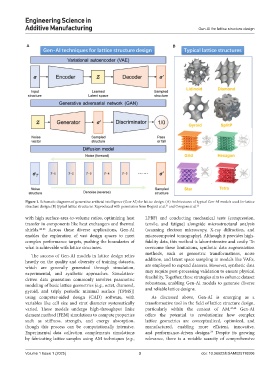
            Figure 1. Schematic diagrams of generative artificial intelligence (Gen-AI) for lattice design. (A) Architectures of typical Gen-AI models used for lattice
            structure design; (B) typical lattice structures. Reproduced with permission from Bogusz et al.  and Gongora et al. 22
                                                                        21
            with high surface-area-to-volume ratios, optimizing heat   LPBF)  and  conducting  mechanical  tests  (compression,
            transfer in components like heat exchangers and thermal   tensile, and fatigue) alongside microstructural analysis
            shields. 44-46  Across these diverse applications, Gen-AI   (scanning electron microscopy, X-ray diffraction, and
            enables  the  exploration  of vast  design spaces  to  meet   microcomputed tomography). Although it provides high-
            complex performance targets, pushing the boundaries of   fidelity data, this method is labor-intensive and costly. To
            what is achievable with lattice structures.        overcome these limitations, synthetic data augmentation
              The success of Gen-AI models in lattice design relies   methods, such as geometric transformations, noise
            heavily on the quality and diversity of training datasets,   addition, and latent space sampling in models like VAEs,
            which are generally generated through simulation,   are employed to expand datasets. However, synthetic data
            experimental, and synthetic approaches. Simulation-  may require post-processing validation to ensure physical
            driven data generation commonly involves parametric   feasibility. Together, these strategies aim to enhance dataset
            modeling of basic lattice geometries (e.g., octet, diamond,   robustness, enabling Gen-AI models to generate diverse
            gyroid, and triply periodic minimal surface [TPMS])   and reliable lattice designs.
            using computer-aided design (CAD) software, with     As discussed above, Gen-AI is emerging as a
            variables like cell size and strut diameter systematically   transformative tool in the field of lattice structure design,
            varied. These models undergo high-throughput finite   particularly within the context of AM. 47,48  Gen-AI
            element method (FEM) simulations to compute properties   offers the potential to revolutionize how complex
            such as stiffness, strength, and energy absorption,   lattice geometries are conceptualized, optimized, and
            though this process can be computationally intensive.   manufactured, enabling more efficient, innovative,
            Experimental data collection complements simulations   and performance-driven designs.  Despite its growing
                                                                                           24
            by fabricating lattice samples using AM techniques (e.g.,   relevance, there is a notable scarcity of comprehensive

            Volume 1 Issue 1 (2025)                         3                          doi: 10.36922/ESAM025110006

