


Page 42 - ESAM-1-1
P. 42
Engineering Science in
            Additive Manufacturing                                                   Gen-AI for lattice structure design


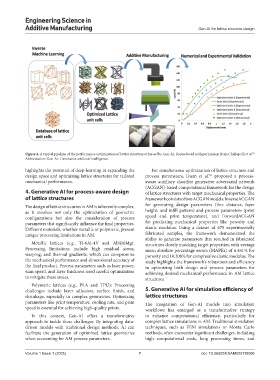
            Figure 4. A typical pipeline of the performance optimization of lattice structure achieved by Gen-AI. Reproduced with permission from Challapalli et al. 53
            Abbreviation: Gen-AI: Generative artificial intelligence.
            highlights the potential of deep learning in expanding the   For simultaneous optimization of lattice structure and
            design space and optimizing lattice structures for tailored   process parameters, Duan  et al.  proposed a process-
                                                                                          56
            mechanical performance.                            aware auxiliary classifier generative adversarial network
                                                               (ACGAN)-based computational framework for the design
            4. Generative AI for process-aware design          of lattice structures with target mechanical properties. The
            of lattice structures                              framework consists of two ACGAN models: InverseACGAN
            The design of lattice structures in AM is inherently complex,   for generating design parameters (line distance, layer
            as it involves not only the optimization of geometric   height, and infill pattern) and process parameters (print
            configurations but also the consideration of process   speed and print temperature), and ForwardACGAN
            parameters that significantly influence the final properties.   for predicting mechanical properties like porosity and
            Different materials, whether metallic or polymeric, present   elastic modulus. Using a dataset of 675 experimentally
            unique processing limitations in AM.               fabricated samples, the framework demonstrated the
                                                               ability to generate parameters that resulted in fabricated
              Metallic lattices (e.g., Ti-6Al-4V and AlSi10Mg):   structures closely matching target properties, with average
            Processing  limitations  include  high  residual  stress,   mean absolute percentage errors (MAPEs) of 6.481% for
            warping, and thermal gradients, which can compromise   porosity and 10.208% for compressive elastic modulus. The
            the mechanical performance and dimensional accuracy of   study highlights the framework’s robustness and efficiency
            the final product. Process parameters such as laser power,   in optimizing both design and process parameters for
            scan speed, and layer thickness need careful optimization   achieving desired mechanical performance in AM lattice
            to mitigate these issues.                          structures.
              Polymeric lattices (e.g., PLA and TPU): Processing
            challenges include layer adhesion, surface finish, and   5. Generative AI for simulation efficiency of
            shrinkage, especially in complex geometries. Optimizing   lattice structures
            parameters like print temperature, cooling rate, and print   The integration of Gen-AI models into simulation
            speed is essential for achieving high-quality prints.  workflows has emerged as a transformative strategy
              In this context, Gen-AI offers a transformative   to enhance computational efficiency, particularly for
            approach to tackle these challenges. By integrating data-  complex lattice simulations in AM. Traditional simulation
            driven models with traditional design methods, AI can   techniques, such as FEM simulations or Monte Carlo
            facilitate the generation of optimized lattice geometries   methods, often encounter significant challenges, including
            when accounting for AM process parameters.         high computational costs, long processing times, and


            Volume 1 Issue 1 (2025)                         7                          doi: 10.36922/ESAM025110006

