


Page 39 - ESAM-1-1
P. 39
Engineering Science in
            Additive Manufacturing                                                   Gen-AI for lattice structure design


                         A


                         B


                        C


                         D


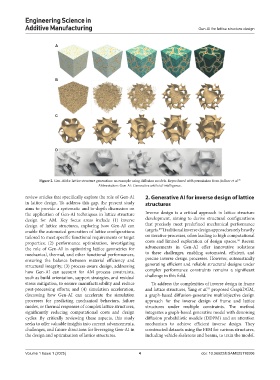
                  Figure 2. Gen-AI for lattice structure generation: an example using diffusion models. Reproduced with permission from Jadhav et al. 35
                                           Abbreviation: Gen-AI: Generative artificial intelligence.

            review articles that specifically explore the role of Gen-AI   2. Generative AI for inverse design of lattice
            in lattice design. To address this  gap, the present study   structures
            aims to provide a systematic and in-depth discussion on
            the application of Gen-AI techniques in lattice structure   Inverse design is a critical approach in lattice structure
            design for AM. Key focus areas include (1) inverse   development, aiming to derive structural configurations
            design of lattice structures, exploring how Gen-AI can   that precisely meet predefined mechanical performance
                                                                     49
            enable the automated generation of lattice configurations   targets.  Traditional inverse design approaches rely heavily
            tailored to meet specific functional requirements or target   on iterative processes, often leading to high computational
                                                                                                      50
            properties; (2) performance optimization, investigating   costs and limited exploration of design spaces.  Recent
            the role of Gen-AI in optimizing lattice geometries for   advancements in Gen-AI offer innovative solutions
            mechanical, thermal, and other functional performances,   to these challenges, enabling automated, efficient, and
            ensuring the balance between material efficiency and   precise inverse design processes. However, automatically
            structural integrity; (3) process-aware design, addressing   generating efficient and reliable structural designs under
            how Gen-AI can account for AM process constraints,   complex performance constraints remains a significant
            such as build orientation, support strategies, and residual   challenge in this field.
            stress mitigation, to ensure manufacturability and reduce   To address the complexities of inverse design in frame
            post-processing efforts; and (4) simulation acceleration,   and lattice structures, Yang et al.  proposed GraphDGM,
                                                                                         51
            discussing how Gen-AI can accelerate the simulation   a graph-based diffusion-generative multiobjective design
            processes for predicting mechanical behaviors, failure   approach for the inverse design of frame and lattice
            modes, or thermal responses of complex lattice structures,   structures under multiple constraints. The method
            significantly  reducing  computational  costs  and  design   integrates a graph-based generative model with denoising
            cycles. By critically reviewing these aspects, this study   diffusion probabilistic models (DDPM) and an attention
            seeks to offer valuable insights into current advancements,   mechanism to achieve efficient inverse design. They
            challenges, and future directions for leveraging Gen-AI in   constructed datasets using the FEM for various structures,
            the design and optimization of lattice structures.  including vehicle skeletons and beams, to train the model.


            Volume 1 Issue 1 (2025)                         4                          doi: 10.36922/ESAM025110006

