


Page 9 - ESAM-1-1
P. 9
Engineering Science in
            Additive Manufacturing                                        ML in MAM monitoring and control through images


                          A                                    B


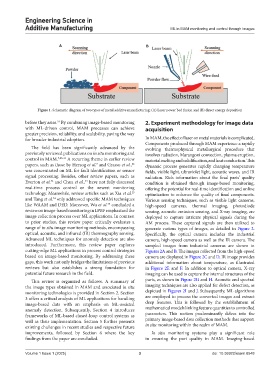
                 Figure 1. Schematic diagram of two types of metal additive manufacturing: (A) Laser power bed fusion and (B) direct energy deposition


            before they arise.  By combining image-based monitoring   2. Experiment methodology for image data
                         24
            with ML-driven control, MAM processes can achieve   acquisition
            greater precision, reliability, and scalability, paving the way
            for broader industrial adoption.                   In MAM, the effect of laser on metal materials is complicated.
                                                               Components produced through MAM experience a rapidly
              The field has been significantly advanced by the   evolving thermophysical metallurgical procedure that
            previously reviewed publications on in situ monitoring and   involves radiation, Marangoni convection, plasma eruption,
            control in MAM. 7,25-31  A recurring theme in earlier review   material melting and solidification, and heat conduction. This
            papers, such as those by Herzog et al.  and Grasso et al.,    dynamic process generates rapidly changing temperature
                                                         26
                                          7
            was concentrated on ML for fault identification or sensor   fields, visible light, ultraviolet light, acoustic waves, and IR
            signal processing. Besides, other review papers, such as   radiation. Rich information about the final parts’ quality
            Everton et al.  and Chua et al.,  have not fully discussed   condition is obtained through image-based monitoring,
                                     33
                       32
            real-time process control or the newest monitoring   offering the potential for real-time identification and online
            technology. Meanwhile, review articles such as Xia et al.    optimization to enhance the quality of final components.
                                                         25
            and Tang et al.  only addressed specific MAM techniques   Various sensing techniques, such as visible light cameras,
                        34
            like WAAM and DED. Moreover, Wu et al.  concluded a   high-speed cameras, thermal imaging, photodiode
                                               35
            review on image-based monitoring in LPBF emphasized the   sensing, acoustic emission sensing, and X-ray imaging, are
            image collection process over ML applications. In contrast   deployed to capture intricate physical signals during the
            to prior studies, this review paper critically evaluates a   AM process. These captured signals are then utilized to
            range of in situ image monitoring methods, encompassing   generate  various  types  of  images,  as  detailed  in  Figure  2.
            optical, acoustic, and infrared (IR) thermography sensing.   Specifically, the optical camera includes the industrial
            Advanced ML techniques for anomaly detection are also   camera, high-speed camera as well as the IR camera. The
            introduced.  Furthermore,  this  review  paper  explores   sampled  images  from  industrial  cameras  are  shown  in
            cutting-edge ML applications in process control strategies   Figures 2A and B. The images collected from the high-speed
            based on image-based monitoring. By addressing these   camera are displayed in Figure 2C and D. IR image provides
            gaps, this work not only bridges the limitations of previous   additional information about temperature, as illustrated
            reviews but also establishes a strong foundation for   in  Figure  2E  and  F. In addition to optical camera, X-ray
            potential future research in the field.            imaging can be used to capture the internal structures of the
              This review is organized as follows. A  summary of   parts, as shown in Figure 2G and H. Acoustic and spectral
            the image types obtained in MAM and associated in situ   imaging techniques are also applied for defect detection, as
            monitoring technologies is provided in Section 2. Section   depicted in Figures 2I and J. Subsequently, ML algorithms
            3 offers a critical analysis of ML applications for handling   are employed to process the converted images and extract
            image-based data with an emphasis on ML-assisted   deep features. This is followed by the establishment of
            anomaly detection. Subsequently, Section 4 introduces   mathematical models linking feature quantities to controlled
            frameworks of ML-based closed-loop control systems as   parameters. This section predominantly delves into the
            well as their implementation. Section 5 further presents   primary image-based data collection methods that support
            existing challenges in recent studies and respective future   in situ monitoring within the realm of MAM.
            improvements, followed by Section 6 where the key    In situ monitoring systems play a significant role
            findings from the paper are concluded.             in ensuring the part quality in MAM. Imaging-based


            Volume 1 Issue 1 (2025)                         3                              doi: 10.36922/esam.8548

