


Page 11 - ESAM-1-1
P. 11
Engineering Science in
            Additive Manufacturing                                        ML in MAM monitoring and control through images


            sample under investigation. Then, the camera is connected   real-time thermography to detect anomalies with a
            to a computer system equipped with image processing   broader observation range and increased installation
            software for real-time analysis and recording of the images   flexibility.  For instance, Marshall et al.  installed an IR
                                                                       53
                                                                                               54
            captured. Furthermore, adequate lighting conditions are   camera to monitor the changing temperature dynamics
            maintained to ensure optimal visibility of the sample during   of bulk part and a pyrometer for measuring the melt
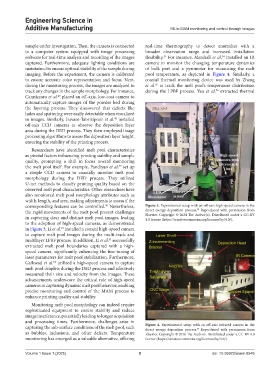
            imaging. Before the experiment, the camera is calibrated   pool temperature, as depicted in  Figure  4. Similarly, a
            to ensure accurate color representation and focus. Next,   coaxial thermal monitoring device was used by Zheng
            during the monitoring process, the images are analyzed to   et  al.  to track the melt pool’s temperature distribution
                                                                   55
            track any changes in the sample morphology. For instance,   during the LPBF process. Yan  et al.  extracted thermal
                                                                                             56
            Cannizzaro et al.  placed an off-axis, low-cost camera to
                          47
            automatically capture images of the powder bed during
            the  layering  process.  They  discovered  that  defects  like
            holes and spattering were easily detectable when visualized
            in images. Similarly, Iravani-Tabrizipour et al.  installed
                                                  48
            off-axis CCD cameras to observe the deposition layer
            area during the DED process. They then employed image
            processing algorithms to assess the deposition layer height,
            ensuring the stability of the printing process.
              Researchers  have  identified  melt  pool  characteristics
            as pivotal factors influencing printing stability and sample
            quality, prompting a shift in focus toward monitoring
            the melt pool itself. For example, Pandiyan et al.  set up
                                                    49
            a simple CCD camera to coaxially monitor melt pool
            morphology during the DED process. They utilized
            U-net methods to classify printing quality based on the
            observed melt pool characteristics. Other researchers have
            also monitored melt pool morphology attributes such as
            width, length, and area, making adjustments to assess if the
            corresponding features can be controlled.  Nevertheless,   Figure 3. Experimental setup with an off-axis high-speed camera in the
                                              50
                                                                                     39
            the rapid movements of the melt pool present challenges   direct energy deposition process.  Reproduced with permission from
                                                               Elsevier. Copyright © 2024 The Author(s). Distributed under a CC-BY
            in capturing clear and distinct melt pool images, leading   4.0 license (https://creativecommons.org/licenses/by/4.0/).
            to the adoption of high-speed cameras, as demonstrated
            in Figure 3. Li et al.  installed a coaxial high-speed camera
                           46
            to capture melt pool images during the multi-track and
            multilayer LPBF process. In addition, Li et al.  successfully
                                               51
            extracted melt pool boundaries captured with a high-
            speed camera, significantly enhancing the fine-tuning of
            laser parameters for melt pool stabilization. Furthermore,
            Gaikwad et al.  utilized a high-speed camera to capture
                        52
            melt pool droplets during the DED process and effectively
            measured their size and velocity from the images. These
            advancements underscore the critical role of high-speed
            cameras in capturing dynamic melt pool behavior, enabling
            precise monitoring and control of the MAM process to
            enhance printing quality and stability.
              Monitoring melt pool morphology can indeed require
            sophisticated equipment to ensure stability and reduce
            image interference, potentially leading to longer acquisition
            and processing  times.  Furthermore, challenges arise in
            capturing the sub-surface conditions of the melt pool, such   Figure  4. Experimental setup with an off-axis infrared camera in the
                                                               direct energy deposition process.  Reproduced with permission from
                                                                                     54
            as bubbles, inclusions, and other defects. Temperature   Elsevier. Copyright © 2016 The Authors. Distributed under a CC-BY 4.0
            monitoring has emerged as a valuable alternative, offering   license (https://creativecommons.org/licenses/by/4.0/).

            Volume 1 Issue 1 (2025)                         5                              doi: 10.36922/esam.8548

