


Page 98 - ESAM-1-1
P. 98
Engineering Science in
            Additive Manufacturing                                               Mechanical property of metal-based IPC


                          A                                            C             D


                          B


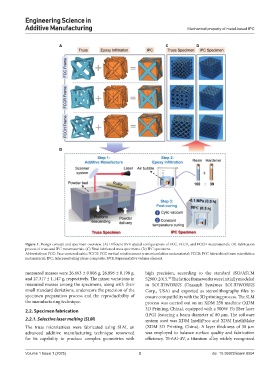
            Figure 1. Design concept and specimen overview. (A) Different RVE spatial configurations of FCC, FCCR, and FCCH metamaterials. (B) Fabrication
            process of truss and IPC metamaterials. (C) Final fabricated truss specimens. (D) IPC specimens.
            Abbreviations: FCC: Face-centered cubic; FCCH: FCC vertical reinforcement truss microlattice metamaterial; FCCR: FCC hierarchical truss microlattice
            metamaterial; IPC: Interpenetrating phase composite; RVE: Representative volume element.


            measured masses were 26.663 ± 0.006 g, 26.896 ± 0.198 g,   high precision, according to the standard ISO/ASTM
            and 27.317 ± 1.147 g, respectively. The minor variations in   52900: 2015.  The lattice frameworks were initially modeled
                                                                         38
            measured masses among the specimens, along with their   in SOLIDWORKS (Dassault Systèmes SOLIDWORKS
            small standard deviations, underscore the precision of the   Corp., USA) and exported as stereolithography files to
            specimen preparation process and  the reproducibility of   ensure compatibility with the 3D printing process. The SLM
            the manufacturing technique.                       process was carried out on an XDM 250 machine (XDM

            2.2. Specimen fabrication                          3D Printing, China), equipped with a 500W Yb fiber laser
                                                               (IPG) featuring a beam diameter of 80 µm. The software
            2.2.1. Selective laser melting (SLM)               system used was XDM IntelliProc and XDM IntelliMake
            The truss microlattices were fabricated using SLM, an   (XDM 3D Printing, China). A layer thickness of 30 µm
            advanced additive manufacturing technique renowned   was employed to balance surface quality and fabrication
            for its capability to produce complex geometries with   efficiency. Ti-6Al-4V, a titanium alloy widely recognized


            Volume 1 Issue 1 (2025)                         3                              doi: 10.36922/esam.8554

