


Page 100 - ESAM-1-1
P. 100
Engineering Science in
            Additive Manufacturing                                               Mechanical property of metal-based IPC


                          A                        B                       C


                          D                        E                       F


                          G                       H                        I


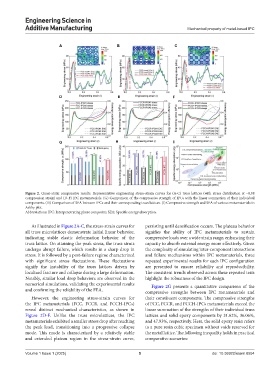
            Figure 2. Quasi-static compressive results. Representative engineering stress-strain curves for (A-C) truss lattices (with stress distribution at ~0.08
            compression strain) and (D-F) IPC metamaterials. (G) Comparison of the compressive strength of IPCs with the linear summation of their individual
            components. (H) Comparison of SEA between IPCs and their corresponding truss lattices. (I) Compressive strength and SEA of various metamaterials in
            Ashby plot.
            Abbreviations: IPC: Interpenetrating phase composite; SEA: Specific energy absorption.

              As illustrated in Figure 2A-C, the stress-strain curves for   persisting until densification occurs. The plateau behavior
            all truss microlattices demonstrate initial linear behavior,   signifies the ability of IPC metamaterials to sustain
            indicating stable elastic deformation behavior of the   compressive loads over a wide strain range, enhancing their
            truss lattice. On attaining the peak stress, the truss struts   capacity to absorb external energy more effectively. Given
            undergo abrupt failure, which results in a sharp drop in   the complexity of simulating inter-component interactions
            stress. It is followed by a post-failure regime characterized   and failure mechanisms within IPC metamaterials, three
            with significant stress fluctuations. These fluctuations   repeated experimental results for each IPC configuration
            signify the instability of the truss lattices driven by   are presented to ensure reliability and reproducibility.
            localized fracture and collapse during a large deformation.   The consistent trends observed across these repeated tests
            Notably, similar load drop behaviors are observed in the   highlight the robustness of the IPC design.
            numerical simulations, validating the experimental results   Figure  2G presents a quantitative comparison of the
            and confirming the reliability of the FEA.         compressive strengths between IPC metamaterials and
              However, the engineering stress-strain curves for   their constituent components. The compressive strengths
            the IPC metamaterials (FCC, FCCR, and FCCH-IPCs)   of FCC, FCCR, and FCCH-IPCs metamaterials exceed the
            reveal distinct mechanical characteristics, as shown in   linear summation of the strengths of their individual truss
            Figure  2D-F. Unlike the truss microlattices, the IPC   lattices and solid epoxy components by 31.62%, 36.06%,
            metamaterials exhibited a smaller stress drop after reaching   and 47.93%, respectively. Here, the solid epoxy resin refers
            the  peak  load,  transitioning  into  a  progressive  collapse   to a pure resin cubic specimen without voids reserved for
            mode.  This  mode  is characterized  by  a relatively stable   the metal lattice. The following inequality holds in practical
            and extended plateau region in the stress-strain curve,   comparative scenarios:


            Volume 1 Issue 1 (2025)                         5                              doi: 10.36922/esam.8554

