


Page 13 - ESAM-1-2
P. 13
Engineering Science in
            Additive Manufacturing                                             AM-CFRP structures for EMWA properties


              The homogeneity, adherence, and thickness of the   presents nanoporosity and heterostructures to enhance
            coatings are largely determined by the coating processes,   dielectric loss and bandwidth. The hierarchical CoNC @
            such as chemical vapor deposition, electrochemical   CF-PLA composites stand out by integrating atomic-scale
            deposition, or  electroless plating. While  hybrid coatings   magnetic sites with 3D-printed polymer matrices, achieving
            that combine conductive and magnetic materials, like   deep absorption (−45  dB) through multi-scale design
            FeO₄-polypyrrole multilayers, have  shown synergistic   (Figure  3C). In contrast, the CNT/CF and SiC  hybrids
                                                                                                      f
            effects for broadband absorption, a thin and uniform nickel   prioritize high-frequency performance (CNTs) or thermal
            coating on CFs has been demonstrated to achieve reflection   stability (SiC ), demonstrating adaptability to operational
                                                                         f
            losses below −40 dB in the Ku-band. These coated CFs can   environments (Figure  3D). Comparatively, methods
            be further incorporated into polymer matrices through   shown in Figure 3B and C excel in broadband absorption
            additive printing to create intricate, lightweight absorbers   due to their porous and hierarchical architectures, whereas
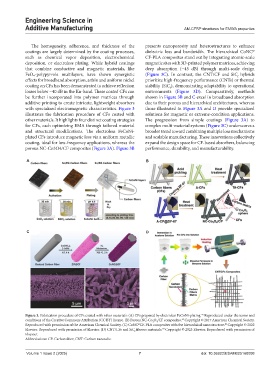
            with specialized electromagnetic characteristics. Figure 3   those illustrated in Figure 3A and D provide specialized
            illustrates the fabrication procedure of CFs coated with   solutions for magnetic or extreme-condition applications.
            other materials. It highlights four distinct coating strategies   The progression from simple coatings (Figure  3A) to
            for CFs, each optimizing EMA through tailored material   complex multi-material systems (Figure 3C) underscores a
            and structural modifications. The electroless FeCoNi-  broader trend toward combining multiple loss mechanisms
            plated CFs introduce magnetic loss via a uniform metallic   and scalable manufacturing. These innovations collectively
            coating, ideal for low-frequency applications, whereas the   expand the design space for CF-based absorbers, balancing
            porous NC-Co3O4/CF composites (Figure 3A). Figure 3B   performance, durability, and manufacturability.

            A                                                  B


            C                                                  D


            Figure 3. Fabrication procedure of CFs coated with other materials: (A) CFs prepared by electroless FeCoNi-plating.  Reproduced under the terms and
                                                                                       44
            conditions of the Creative Commons Attribution (CC BY) license. (B) Porous NC-Co O /CF composites.  Copyright © 2017 American Chemical Society.
                                                                              45
                                                                  3
                                                                    4
            Reproduced with permission of the American Chemical Society. (C) CoNC CF-PLA composites with the hierarchical nanostructure.  Copyright © 2022
                                                                                                 46
                                                            @
            Elsevier. Reproduced with permission of Elsevier. (D) CNT/CFs and SiC  fibrous materials.  Copyright © 2023 Elsevier. Reproduced with permission of
                                                                      33
                                                          f
            Elsevier.
            Abbreviations: CF: Carbon fiber; CNT: Carbon nanotube.
             Volume 1 Issue 2 (2025)                        7                          doi: 10.36922/ESAM025160008

