


Page 15 - ESAM-1-2
P. 15
Engineering Science in
            Additive Manufacturing                                             AM-CFRP structures for EMWA properties


            A                                                  B


            C                                                  D


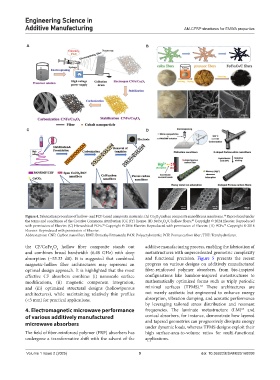
            Figure 4. Fabrication procedure of hollow- and PCF-based composite materials: (A) Co O /carbon composite nanofibrous membrane.  Reproduced under
                                                                                                48
                                                                   3
                                                                    4
            the terms and conditions of the Creative Commons Attribution (CC BY) license. (B) Fe/Fe O /C hollow fibers.  Copyright © 2024 Elsevier. Reproduced
                                                                                   49
                                                                      3
                                                                       4
            with permission of Elsevier. (C) Hierarchical PCFs.  Copyright © 2016 Elsevier. Reproduced with permission of Elsevier. (D) PCFs.  Copyright © 2018
                                             50
                                                                                                51
            Elsevier. Reproduced with permission of Elsevier.
            Abbreviations: CNF: Carbon nanofiber; DMF: Dimethylfirmamide; PAN: Polyacrylonitrile; PCF: Porous carbon fiber; THF: Tetrahydrofuran.
            the CF/CoFe O  hollow fiber composite stands out   additive manufacturing process, enabling the fabrication of
                       2
                         4
            and combines broad bandwidth (6.48 GHz) with deep   metastructures with unprecedented geometric complexity
            absorption (−55.33  dB). It is suggested that combined   and functional precision.  Figure  5 presents the recent
            magnetic-hollow fiber architectures may represent an   progress on various designs on additively manufactured
            optimal design approach. It is highlighted that the most   fiber-reinforced polymer  absorbers, from bio-inspired
            effective CF absorbers combine: (i) nanoscale surface   configurations like bamboo-inspired metastructures  to
            modifications, (ii) magnetic component integration,   mathematically optimized  forms such as triply periodic
                                                                                      64
            and (iii) optimized structural designs (hollow/porous   minimal surfaces (TPMS).  These architectures are
            architectures), while maintaining relatively thin profiles   not merely aesthetic but engineered to enhance energy
            (<3 mm) for practical applications.                absorption, vibration damping, and acoustic performance
                                                               by leveraging tailored stress distribution and resonant
            4. Electromagnetic microwave performance           frequencies. The laminate metastructure (LM)  and
                                                                                                        65
            of various additively manufactured                 conical absorbers, for instance, demonstrate how layered
            microwave absorbers                                and tapered geometries can progressively dissipate energy
                                                               under dynamic loads, whereas TPMS designs exploit their
            The field of fiber-reinforced polymer (FRP) absorbers has   high surface-area-to-volume ratios for multi-functional
            undergone a transformative shift with the advent of the   applications.

             Volume 1 Issue 2 (2025)                        9                          doi: 10.36922/ESAM025160008

