


Page 19 - ESAM-1-2
P. 19
Engineering Science in
            Additive Manufacturing                                             AM-CFRP structures for EMWA properties


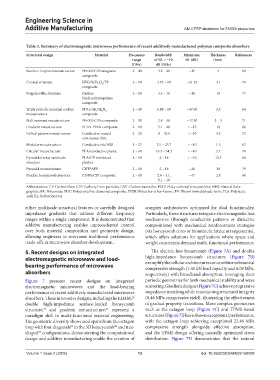
            Table 3. Summary of electromagnetic microwave performance of recent additively manufactured polymer composite absorbers
            Structural design            Material       Frequency   Bandwidth   Minimum   Thickness   References
                                                         range     of RL < −10   RL (dB)    (mm)
                                                         (GHz)     dB (GHz)
            Bamboo-inspired metastructure  PEEK/FCIPs magnetic   2 – 40  3.2 – 40  −15       3          69
                                    composite
            Conical structure       NFG/Si/Fe O /PF      2 – 18     3.55 – 18    −21.52      21         70
                                            4
                                           3
                                    composite
            Propeller-like structure  Carbon             2 – 18     3.4 – 10     −10         10         77
                                    black-polypropylene
                                    composite
            Triply periodic minimal surface   PDCs-SiC/Si N   4  2 – 18  6.88 – 18  −47.60   3.3        64
                                            3
            metastructure           composite
            Multiresonant metastructure  PEEK/FCIPs composite  2 – 30  2.8 – 30  −17.50     3 – 5       71
            Gradient metastructure  FCIPs-PEEK composite  2 – 18    5.1 – 40     < −15       10         66
            Helical pattern metastructure  Conductive-coated   2 – 20  8 – 18.4  < −10       3.2        72
                                    continuous fibre
            Modular metastructure   Conductive ink/ABS   1 – 27     3.5 – 25.7   < −10       1.5        67
            Circular metastructure  PLA/conductive plastic  2 – 60  16.3 – 54.3  < −10       2.7        78
            Pyramidal array sandwich   PLA/CF-reinforced   4 – 18    4 – 18      ≈ −10       13.5       68
            structure               plastics
            Pyramid metastructure   CNT APP              2 – 18      2 – 18      −30         20         79
                                       @
            Flexible honeycomb absorber  CF/PA/CIP composite  2 – 18  2.8 – 3.1,   −47       2.8        80
                                                                    5.1 – 18
            Abbreviations: CF: Carbon fiber; CIP: Carbonyl iron particles; CNT: Carbon nanotube; FCIP: Flaky carbonyl iron particles; NFG: Natural flake
            graphite; PA: Polyamide; PDC: Polycrystalline diamond composite; PEEK: Polyether-ether-ketone; PF: Phenol formaldehyde resin; PLA: Polylactic
            acid; RL: Reflection loss.

            either multiscale structural features or carefully designed   complex architectures optimized for dual functionality.
            impedance gradients that address different frequency   Particularly, these structures integrate electromagnetic loss
            ranges within a single component. It is demonstrated that   mechanisms  (through  conductive  patterns  or  dielectric
            additive manufacturing enables unprecedented control   compositions) with mechanical reinforcement strategies
            over both material composition and geometric design,   (via honeycomb cores or biomimetic lattice arrangements),
            allowing engineers to overcome traditional performance   which offers solutions for applications where space and
            trade-offs in microwave absorber development.      weight constraints demand multi-functional performance.
            5. Recent designs on integrated                      The electric-loss honeycomb (Figure  7A) and double
            electromagnetic microwave and load-                high-impedance honeycomb structures (Figure  7B)
                                                               exemplify the cellular architectures can combine substantial
            bearing performance of microwave                   compressive strength (1.41 kN load capacity and 6.09 MPa,
            absorbers                                          respectively) with broadband absorption, leveraging their

            Figure  7  presents recent designs on integrated   periodic geometries for both mechanical stability and wave
            electromagnetic microwaves and the load-bearing    scattering. Gradient designs (Figure 7C) achieve progressive
            performance of recent additively manufactured microwave   impedance matching while maintaining structural integrity
            absorbers. These innovative designs, including the ELHM,    (8.46 MPa compressive yield), illustrating the effectiveness
                                                         22
            double high-impedance surface-loaded honeycomb     of gradual property transitions. More complex geometries
                                              66
            structure,  and gradient metastructure,  represent a   such as the octagon loop (Figure  7C) and TPMS-based
                   75
            paradigm shift in multi-functional material engineering.   structures (Figure 7I) have shown exceptional performance,
            The geometric diversity showcased spans from the octagon   with the octagon loop achieving exceptional 22.46 MPa
            loop with four diagonals  to the 3D honeycomb  and tree-  compressive strength alongside effective absorption,
                                                  82
                               81
            shaped  configurations, demonstrating the computational   and the TPMS design offering naturally optimized stress
                 83
            design and additive manufacturing enable the creation of   distribution.  Figure  7H demonstrates that the natural
             Volume 1 Issue 2 (2025)                        13                         doi: 10.36922/ESAM025160008

