


Page 22 - ESAM-1-2
P. 22
Engineering Science in
            Additive Manufacturing                                             AM-CFRP structures for EMWA properties


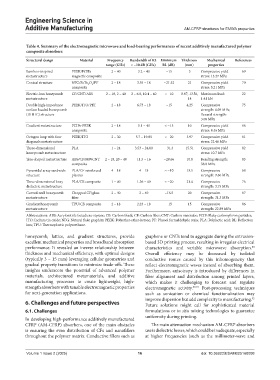
            Table 4. Summary of the electromagnetic microwave and load‑bearing performances of recent additively manufactured polymer
            composite absorbers
            Structural design      Material    Frequency   Bandwidth of RL  Minimum   Thickness   Mechanical   References
                                              range (GHz)  < −10 dB (GHz)  RL (dB)  (mm)  properties
            Bamboo-inspired     PEEK/FCIPs      2 – 40      3.2 – 40    −15      3    Compressive yield   69
            metastructure       magnetic composite                                    stress: 13.27 MPa
            Conical structure   NFG/Si/Fe O /PF   2 – 18   3.55 – 18   −21.52    21   Compressive yield   70
                                        4
                                      3
                                composite                                             stress: 5.21 MPa
            Electric-loss honeycomb   CF/CNT/ABS  2 – 18, 2 – 40  2 – 6.8, 10.4 – 40  < −10  8.67, 13.56,  Maximum load:   22
            metastructure                                                        14   1.41 kN
            Double high-impedance   PEEK/ITO/PET  2 – 18   6.73 – 18    −15     4.25  Compressive       75
            surface-loaded honeycomb                                                  strength: 6.09 MPa;
            (DHHC) structure                                                          flexural strength:
                                                                                      3.08 MPa
            Gradient metastructure  FCIPs-PEEK   2 – 18     5.1 – 40   < −15     10   Compressive yield   66
                                composite                                             stress: 8.46 MPa
            Octagon loop with four   PEEK/ITO   2 – 30     5.7 – 19.85  < −20   3.97  Compressive yield   81
            diagonals metastructure                                                   stress: 22.46 MPa
            Three-dimensional   PLA             1 – 24    3.53 – 24.00  −31.3   15.51  Compressive yield   82
            honeycomb metastructure                                                   stress: 10.7 MPa
            Tree-shaped metastructure  ABS/CF/MWCNT   2 – 18, 20 – 40  11.5 – 16  −28.66  10.8  Bending strength:   83
                                composite                                             38.8 MPa
            Pyramidal array sandwich   PLA/CF-reinforced   4 – 18  4 – 18  ≈ −10  13.5  Compressive     68
            structure           plastics                                              strength: 9.60 MPa
            Three-dimensional lossy   PLA/CB composite  1 – 40  1.36 – 40  < −20  21.4  Compressive     76
            dielectric metastructure                                                  strength: 3.75 MPa
            Curved-wall honeycomb   Chopped CF/glass   2 – 40  2 – 40  −16.5     20   Compressive       87
            metastructure       fiber                                                 strength: 31.3 MPa
            Gradient honeycomb   TPU/CB composite  2 – 18  2.23 – 18    −15      15   Compressive       86
            metastructure                                                             strength: 22.89 MPa
            Abbreviations: ABS: Acrylonitrile butadiene styrene; CB: Carbon black; CF: Carbon fiber; CNT: Carbon nanotube; FCIP: Flaky carbonyl iron particles;
            ITO: Indium tin oxide; NFG: Natural flake graphite; PEEK: Polyether-ether-ketone; PF: Phenol formaldehyde resin; PLA: Polylactic acid; RL: Reflection
            loss; TPU: Thermoplastic polyurethane.

            honeycomb,  lattice,  and  gradient  structures,  provide   graphene or CNTs tend to aggregate during the extrusion-
            excellent mechanical properties and broadband absorption   based 3D printing process, resulting in irregular electrical
            performance. It revealed an inverse relationship between   characteristics and variable microwave absorption.
                                                                                                            88
            thickness and mechanical efficiency, with optimal designs   Overall efficiency may be decreased by isolated
            (typically 3 – 15 mm) leveraging cellular geometries and   conductive routes caused by this inhomogeneity that
            gradual property transitions to minimize trade-offs. These   reflect electromagnetic waves instead of absorbing them.
            insights underscore the potential of advanced polymer   Furthermore, anisotropy is introduced by differences in
            materials, architectured metamaterials, and  additive   fiber alignment and distribution among printed layers,
            manufacturing  processes  to  create  lightweight,  high-  which makes it challenging to forecast and regulate
            strength absorbers with tunable electromagnetic properties   electromagnetic activity. 89-91  Post-processing techniques
            for next-generation applications.                  such as sonication or chemical functionalization may
                                                                                                            92
                                                               improve dispersion but add complexity to manufacturing.
            6. Challenges and future perspectives              Future solutions might call for sophisticated material
            6.1. Challenges                                    formulations or in situ mixing technologies to guarantee
                                                               uniformity during printing.
            In developing high-performance additively manufactured
            CFRP (AM-CFRP) absorbers, one of the main obstacles   The main attenuation mechanism AM-CFRP absorbers
            is ensuring the even distribution of CFs and nanofillers   use is dielectric losses, which could be inadequate, especially
            throughout the polymer matrix. Conductive fillers such as   at higher frequencies (such as the millimeter-wave and


             Volume 1 Issue 2 (2025)                        16                         doi: 10.36922/ESAM025160008

