


Page 43 - ESAM-1-2
P. 43
Engineering Science in
            Additive Manufacturing                                          Multi-material additive manufacturing of metals


            A                      B                           An  irregular  elliptical  island-like  heterogeneous  phase
                                                               appeared in both material-rich regions due to the high-
                                                               energy laser beam penetrating through several layers to
                                                               re-melt the solidified SS316L. 56,58,142  The rapid movement
                                                               of the laser beam caused the molten pool to be unstable.
                                                               However,  CuSn10/SS316L  exhibited  fewer  cracks  than
                                                               SS316L/CuSn10. The crack formation was attributed
            C                      D                           to liquid metal embrittlement, driven by differential
                                                               elemental diffusion rates at high temperatures, consistent
                                                               with the Kirkendall effect, similar to observations by
                                                               Liu  et al.  Similarly, in SS316L/C18400  and SS316L/
                                                                                                141
                                                                       56
                                                                     56
                                                               C25400  bimetallic structures,  cracks were observed at
                                                               the transition region and extended toward the SS-rich
                                                               region in both alloy combinations due to the high residual
                                                               stress in SS316L owing to its low CTE. A similar behavior
            E                                                  was observed in the SS316L/Cu/Ti-6Al-4V  MMAM
                                                                                                    123
                                                               structure using a Cu-alloy as an intermediate bonding
                                                               layer (IBL).
                                                                 From these studies, it is evident that in SS/Cu bimetallic
                                                               structures, crack formation is primarily driven by dissimilar
                                                               thermal and mechanical properties between metal alloys.
                                                               Compared to SS/Ni bimetallic structures, which generally
            F                        G                         exhibited good metallurgical bonding, SS/Cu combinations
                                                               were more prone to cracking, largely due to the significantly
                                                               higher thermal conductivity of Cu relative to SS. In SS/Cu
                                                               structures, cracks propagated in the Cu-rich region due to
                                                               the deeper penetration of Cu into the SS alloy. Conversely,
                                                               in Cu/SS bimetallic, a small amount of Cu penetrates the
                                                               interface of SS316L, and a brittle Cu film with low strength
                                                               is formed. In the subsequent cooling process, due to the
                                                               difference in the thermophysical properties between Cu
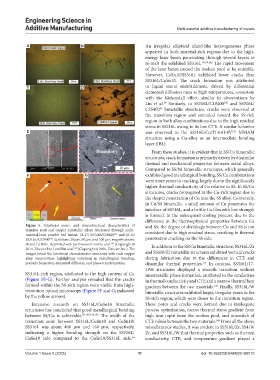
            Figure  5.  Interfacial meso-  and microstructural characteristics of   and SS, the degree of shrinkage between Cu and SS is not
            stainless steel and copper bimetallic alloys fabricated through multi-  consistent due to high residual stress, resulting in thermal
            material-laser powder bed fusion. (A-D) SS316L/C18400  and (E-G)
                                                  141
                      140
            SS316L/C52400 . Scale bars: 20 μm, 50 μm, and 100 μm, magnifications:   penetration cracking on the SS side.
                                                141
            (E and G) 300×. Reprinted with permission from Liu et al.  (Copyright ©   In addition to the SS/Cu bimetallic structure, SS316L/Zr
                                 140
            2014, Elsevier Inc.) and Bai et al.  (Copyright © 2020, Elsevier Inc.). The
            images reveal the interfacial characteristics associated with each copper   and SS410/Zr bimetallic structures exhibited vertical cracks
            alloy composition, highlighting variations in metallurgical bonding,   during fabrication due to the differences in CTE and
            porosity formation, elemental diffusion, and phase transformation.  dissimilar  thermal  properties.   In contrast, SS316L/17-
                                                                                       171
                                                               4PH structures displayed  a smooth transition without
            SS316L-rich region, attributed to the high content of Cu   intermetallic phase formation, attributed to the similarities
            (Figure  5E-G). Further analysis revealed that the cracks   in thermal conductivity and CTE and a narrow thermal heat
            formed within the SS-rich region were visible from high-  gradient between the two materials.  Finally, SS316L/W
                                                                                            147
            resolution optical microscopy (Figure 5F and G; indicated   bimetallic structures exhibited larger, irregular pores in the
            by the yellow arrows).                             SS-rich region, which were closer to the transition region.
              Extensive research on SS316L/CuSn10 bimetallic   These pores and cracks were formed due to inadequate
            structures has concluded that good metallurgical bonding   process optimization, excess thermal stress gradient from
            between SS/Cu is achievable. 58,139,142,183  The width of the   high heat input from the molten pool, and mismatch of
            transition zone between SS316L/CuSn10 and CuSn10/  CTE values between the two materials.  From all the above
                                                                                             148
            SS316L was about 400  μm and 160  μm, respectively,   miscellaneous studies, it was evident in SS316L/Zr, SS410/
            indicating a higher bonding strength on the SS316L/  Zr, and SS316L/W that thermal properties such as thermal
            CuSn10 side compared to the CuSn10/SS316L side.    conductivity, CTE, and temperature gradient played a
                                                         56

            Volume 1 Issue 2 (2025)                         11                         doi: 10.36922/ESAM025180010

