


Page 45 - ESAM-1-2
P. 45
Engineering Science in
            Additive Manufacturing                                          Multi-material additive manufacturing of metals


            attributed to the inadequate energy input during NiCr   A
            layer deposition.  Nevertheless, Ti-6Al-4V/NiCr has
                          122
            amalgamated and formed a strong overall bonding, as
            evidenced by the presence of light and darker circles, as
            observed in Figure 6A. The disparity in thermal properties
            between Nb and NiCr contributes to the observed porosity
            in Ti-6Al-4V/NiCr/SS410 but not in Ti-6Al-4V/Nb/SS410.
            This underscores the importance of material compatibility
            and thermal characteristics when selecting intermediate
            materials. Another interesting investigation looked at the
            effect of transition joints on the interfacial characteristics   B
            in  Ti-6Al-4V/TiC.  Using  dual-material  transition  joints,
            two distinct joints - (1) Butt joint and (2) interlock
            joints illustrated a crack-free interfacial bonding.
                                                         150
            These findings shed light on the effectiveness of different
            joint configurations in achieving a strong and seamless
            bond, providing valuable insights toward the design and
            fabrication of dual-material transition applications. Owing
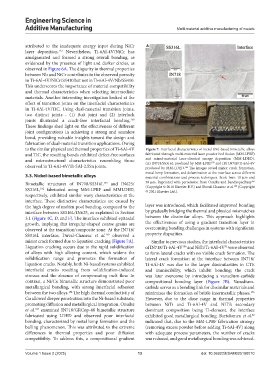
            to the similar physical and thermal properties of Ti-6Al-4V   Figure 7. Interfacial characteristics of nickel (Ni)-based bimetallic alloys
            and TiC, the resulting bonds exhibited defect-free surfaces   fabricated through multi-material laser powder bed fusion (MM-LPBF)
            and microstructural characteristics resembling those   and mixed-material laser-directed energy deposition (MM-LDED).
                                                                                           159
            observed in Ti-6Al-4V/Ti-5Al-2.5Sn joints.         (A) IN718/SS316L produced by MM-LPBF  and (B) IN718/Ti-6Al-4V
                                                               produced by MM-LDED.  The images reveal minor crack formation,
                                                                                156
                                                               metal lump formation, and delamination at the interface across different
            3.3. Nickel-based bimetallic alloys                material combinations and process techniques. Scale bars: 10  μm and
                                                                                                            156
            Bimetallic structures of IN718/SS316L  and IN625/  50 μm. Reprinted with permission from Onuike and Bandyopadhyay
                                             159
                                                                                                     159
            SS316L,  fabricated using MM-LPBF and MMLDED,      (Copyright © 2018 Elsevier B.V.) and Duval-Chaneac et al.  (Copyright
                  132
                                                               © 2021 Elsevier Ltd.).
            respectively, exhibited similar wavy characteristics at the
            interface. These distinctive characteristics are caused by
            the high degree of molten pool banding, compared to the   layer was introduced, which facilitated improved bonding
            interface between SS316L/IN625, as explained in Section   by gradually bridging the thermal and physical mismatches
            3.1 (Figure 4C, D, and F). The interface exhibited epitaxial   between the dissimilar alloys. This approach highlights
            growth, implying that irregular-shaped coarse grains are   the effectiveness of using a gradient transition layer in
            observed at the transition/composite zone. At the IN718/  overcoming bonding challenges in systems with significant
            SS316L interface, Duval-Chaneac  et al.  observed a   property disparities.
                                              159
            minor crack formed due to liquation cracking (Figure 7A).   Similar to previous studies, the interfacial characteristics
            Liquation cracking occurs due to the rapid solidification   of IN718/Ti-6Al-4V  and NiTi/Ti-6Al-4V  were observed
                                                                               156
                                                                                                 52
            of alloys with high alloying content, which widens the   to form lateral cracks with no visible crack formation. The
            solidification range and promotes the formation of   lateral crack formation at the interface between IN718/
            liquation cracks. Notably, both Ni-based systems exhibited   Ti-6Al-4V was due to the larger dissimilarities in CTE
            interfacial cracks resulting from solidification-induced   and immiscibility, which inhibit bonding; the crack
            stresses  and  the  absence  of compensating  melt  flow.  In   was later overcome  by introducing  a vanadium-carbide
            contrast, a Ni/Cu bimetallic structure demonstrated poor   compositional  bonding  layer  (Figure  7B).  Vanadium-
            metallurgical  bonding,  with  strong  interfacial  adhesion   carbide serves as a bonding link for dissimilar materials and
            between the two alloys.  The high thermal conductivity of   minimizes the formation of brittle intermetallic phases.
                              184
                                                                                                            156
            Cu allowed deeper penetration into the Ni-based substrate,   However, due to the close range in thermal properties
            promoting diffusion and metallurgical integration. Onuike   between NiTi and Ti-6Al-4V and NiTi’s secondary
            et al.  examined IN718/GRCop-48 bimetallic structure   dominant  composition  being  Ti-element,  the  interface
                184
            fabricated using  LDED  and  observed poor  interfacial   exhibited good metallurgical bonding. Bartolomeu et al.
                                                                                                            52
            bonding, characterized by metal lump formation and the   indicated that, due to the MM-LPBF fabrication strategy
            balling phenomenon. This was attributed to the extreme   (removing excess powder before adding Ti-6Al-4V) along
            differences in thermal properties and poor diffusion   with adequate process parameters, the number of cracks
            compatibility. To address this, a compositional gradient   was reduced, and good metallurgical bonding was achieved.


            Volume 1 Issue 2 (2025)                         13                         doi: 10.36922/ESAM025180010

