


Page 48 - ESAM-1-2
P. 48
Engineering Science in
            Additive Manufacturing                                          Multi-material additive manufacturing of metals


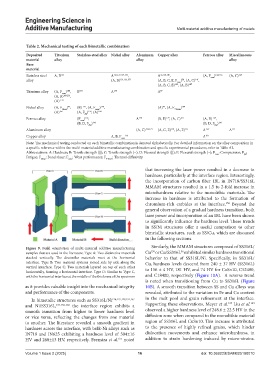
            Table 2. Mechanical testing of each bimetallic combination
            Deposited   Titanium   Stainless steel alloy  Nickel alloy  Aluminum  Copper alloy  Ferrous alloy  Miscellaneous
            material    alloy                              alloy                                   alloy
            Base
            material
            Stainless steel   A, B 123          A 126,127,129,130 ,    A 56,128,140 ,   (A, F ) 144,166  (A, C) 148
                                                                                           com
            alloy                               (A, B) 131,133,157  (A, B, C, E, F ) , (A, C) ,
                                                                                    141
                                                                              58
                                                                            com
                                                                    (A, B, C, E) , (A, B) 187
                                                                           142
            Titanium alloy  (A, F ) ,   E 154   A 155               A 57
                             188
                           com
                        (A, B) 189,151 ,
                        (A)  122
            Nickel alloy  (A, F Shear ) ,   (B)  , (A, F wear ) ,   (A) , (A, F T herm ) 184
                                            158
                                                                      47
                              52
                                    131
                        (A) 156   (A, F ) , (A) 160
                                       159
                                     fat
                                                                                            169
                                     166
                                                                        179
            Ferrous alloy         (F ) ,                   A 190    (B, E) , (A, C) 167  (A, B)  ,
                                   com
                                  (B, D, F ) 170                                       (B, D, F ) 170
                                                                                            Fat
                                       Fat
                                                                          179
            Aluminum alloy                                 (A, C) 172,173  (A, C, E) , (A, E) 175  A  167  A 177
            Copper alloy                        A, B, F  176                           A 167
                                                     com
            Note: The mechanical testing conducted on each bimetallic combination is denoted alphabetically. For detailed information on the alloy composition in
            a specific reference within the multi-material additive manufacturing combination and specific experimental procedures, refer to Table A2.
            Abbreviations: A: Hardness; B: Tensile strength (||); C: Tensile strength (=); D: Flexural strength (||); E: Flexural strength (=); F : Compression; F :
                                                                                                         fat
                                                                                             com
            Fatigue; F  : Bond shear; F  : Wear performance; F  : Thermal diffusivity.
                  Shear       wear            T herm
                                                               that increasing the laser power resulted in a decrease in
                                                               hardness, particularly at the interface region. Interestingly,
                                                               the incorporation of carbon fiber IBL in IN718/SS316L
                                                               MMAM structures resulted in a 1.5 to 2-fold increase in
                                                               microhardness relative to the monolithic materials. The
                                                               increase in hardness is attributed to the formation of
                                                               chromium-rich carbides at the interface.  Beyond the
                                                                                                 158
                                                               general observation of a gradual hardness transition, both
                                                               laser power and incorporation of an IBL have been shown
                                                               to significantly influence the hardness level. These trends
                                                               in SS/Ni structures offer a useful comparison to other
                                                               bimetallic structures, such as SS/Cu, which are discussed
                                                               in the following sections.
            Figure  9.  Build orientation of multi-material additive manufacturing   Similarly, the MMAM structures composed of SS316L/
                                                                              56
                                                                 139
            samples that are used in the literature. Type A: Two distinctive materials   Cu  or Cu/SS316L  exhibited similar hardness transitional
            stacked vertically. The dissimilar materials meet at the horizontal   behavior to that of SS316L/Ni. Specifically, in SS316L/
            interface. Type  B: Two material systems joined side by side along the   Cu, hardness levels descend from 240 ± 37 HV (SS316L)
            vertical interface. Type C: Two materials layered on top of each other   to 156 ± 4 HV, 181 HV, and 74 HV for CuSn10, C52400,
            horizontally, forming a horizontal interface. Type D: Similar to Type C,
            with the horizontal interface at the middle of the thickness of the specimen  and C18400, respectively (Figure 10A).  A reverse trend
                                                               is noted when transitioning from Cu to SS316L (Figure
            as it provides valuable insight into the mechanical integrity   10B). A smooth transition between SS and Cu alloys was
            and performance of the components.                 revealed, attributed to the variation in Fe and Cu content
              In bimetallic structures such as SS316L/Ni 126,127,129,131,157    in the melt pool and grain refinement at the interface.
                                                                                                            139
                                                                                                  139
            and Ni/SS316L, 131,158-160  the interface region exhibits a   Supporting these observations, Meyer et al.  Liu et al.
            smooth  transition  from  higher  to  lower  hardness  level   observed a higher hardness level of 248.6 ± 22.5 HV in the
            or vice versa, reflecting the changes from one material   diffusion zone when compared to the monolithic material
            to  another.  The  literature  revealed a  smooth  gradient  in   region of SS316L and CuSn10. This increase is attributed
            hardness across the interface, with bulk-Ni alloys such as   to the presence of highly refined grains, which hinder
            IN718 and IN625 exhibiting a hardness level of 304±16   dislocation movements and enhance microhardness, in
            HV and 260±13 HV, respectively. Feenstra et al.  noted   addition to strain hardening induced by micro-strains.
                                                   157
            Volume 1 Issue 2 (2025)                         16                         doi: 10.36922/ESAM025180010

