


Page 52 - ESAM-1-2
P. 52
Engineering Science in
            Additive Manufacturing                                          Multi-material additive manufacturing of metals


                         A


                         B


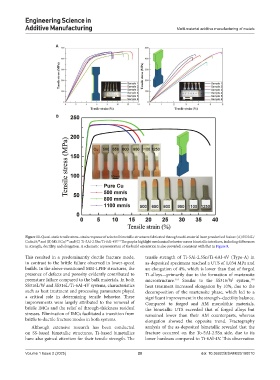
            Figure 11. Quasi-static tensile stress–strain response of selected bimetallic structures fabricated throughmulti-material laser powder bed fusion: (A) SS316L/
            CuSn10;  and (B) MS1/Cu;  and (C) Ti-5Al-2.5Sn/Ti-6Al-4V.  The graphs highlight mechanical behavior across bimetallic interfaces, including differences
                             179
                 58
                                                   151
            in strength, ductility, and elongation. A schematic representation of the build orientation is also provided, consistent with that in Figure 9.
            This resulted in a predominantly ductile fracture mode,   tensile strength of Ti-5Al-2.5Sn/Ti-6Al-4V (Type-A) in
            in contrast to the brittle failure observed in lower-speed   as-deposited specimens reached a UTS of 1,034 MPa and
            builds. In the above-mentioned MM-LPBF structures, the   an elongation of 4%, which is lower than that of forged
            presence of defects and porosity evidently contributed to   Ti-alloys—primarily due to the formation of martensite
            premature failure compared to the bulk materials. In both   microstructure.  Similar to the SS316/W system,
                                                                           151
                                                                                                            148
            SS316L/W and SS316L/Ti-6Al-4V systems, characteristics   heat treatment increased elongation by 10%, due to the
            such as heat treatment and processing parameters played   decomposition of the martensite phase, which led to a
            a critical role in determining tensile behavior. These   significant improvement in the strength–ductility balance.
            improvements were largely attributed to the removal of   Compared to forged and AM monolithic materials,
            brittle IMCs and the relief of through-thickness residual   the  bimetallic UTS exceeded that of  forged  alloys  but
            stresses. Elimination of IMCs facilitated a transition from   remained lower than their AM counterparts, whereas
            brittle to ductile fracture modes in both systems.  elongation showed the opposite trend. Fractography
              Although extensive research has been conducted   analysis of the as-deposited bimetallic revealed that the
            on SS-based bimetallic structures, Ti-based bimetallics   fracture occurred on the To-5Al-2.5Sn side, due to its
            have also gained attention for their tensile strength. The   lower hardness compared to Ti-6Al-4V. This observation


            Volume 1 Issue 2 (2025)                         20                         doi: 10.36922/ESAM025180010

