


Page 54 - ESAM-1-2
P. 54
Engineering Science in
            Additive Manufacturing                                          Multi-material additive manufacturing of metals


            exhibited good metallurgical bonding, though dendritic   such as P21/SS316L  and 17-4PH/SS316L,  both of
                                                                                166
                                                                                                    167
            cracks  were  observed,  attributed  to  CTE  mismatch.  The   which  employ  ferrous  alloys  as  base  materials,  distinct
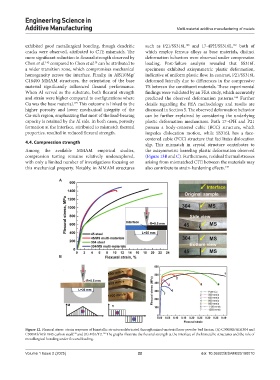
            more significant reduction in flexural strength observed by   deformation behaviors were observed under compression
            Chen et al.  compared to Chen et al.  can be attributed to   loading. Post-failure analysis revealed that SS316L
                                         58
                    142
            a wider transition zone, which compromises mechanical   specimens exhibited axisymmetric plastic deformation,
            homogeneity across the interface. Finally, in AlSi10Mg/  indicative of uniform plastic flow. In contrast, P21/SS316L
            C18400  MMAM  structures,  the  orientation  of  the  base   deformed laterally due to differences in the compressive
            material significantly influenced flexural performance.   YS between the constituent materials. These experimental
            When Al served as the substrate, both flexural strength   findings were validated by an FEA study, which accurately
            and strain were higher compared to configurations where   predicted the observed deformation patterns.  Further
                                                                                                     166
            Cu was the base material.  This outcome is linked to the   details regarding the FEA methodology and results are
                                175
            higher porosity and lower mechanical integrity of the   discussed in Section 5. The observed deformation behavior
            Cu-rich region, emphasizing that most of the load-bearing   can be further explained by considering the underlying
            capacity is retained by the Al side. In both cases, porosity   plastic deformation mechanisms. Both 17-4PH and P21
            formation at the interface, attributed to mismatch thermal   possess a body-centered cubic (BCC) structure, which
            properties, resulted in reduced flexural strength.  impedes dislocation motion, while SS316L has a face-
                                                               centered cubic (FCC) structure that facilitates dislocation
            4.4. Compression strength                          slip. This mismatch in crystal structure contributes to
            Among  the  available  MMAM  empirical  studies,   the axisymmetric barreling plastic deformation observed
            compression testing remains relatively underexplored,   (Figure 13B and C). Furthermore, residual thermal stresses
            with only a limited number of investigations focusing on   arising from mismatched CTE between the materials may
            this mechanical property. Notably, in MMAM structures   also contribute to strain-hardening effects. 147

                          A


                          B


            Figure 12. Flexural stress–strain response of bimetallic structures fabricated through mixed-material laser powder bed fusion. (A) C300MS/AISI304 and
            C300MS/AISI1045 carbon steel;  and (B) MS1/T2.  The graphs illustrate the flexural strength at the interface of the bimetallic structures and the role of
                                170
                                             179
            metallurgical bonding under flexural loading.
            Volume 1 Issue 2 (2025)                         22                         doi: 10.36922/ESAM025180010

