


Page 55 - ESAM-1-2
P. 55
Engineering Science in
            Additive Manufacturing                                          Multi-material additive manufacturing of metals


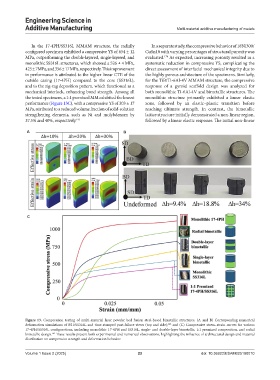
              In the 17-4PH/SS316L MMAM structure, the radially   In a separate study, the compressive behavior of 18Ni300/
            configured specimen exhibited a compressive YS of 654 ± 12   CuSn10 with varying percentages of structural porosity was
            MPa, outperforming the double-layered, single-layered, and   evaluated.  As expected, increasing porosity resulted in a
                                                                       176
            monolithic SS316L structures, which showed a 526 ± 4 MPa,   systematic reduction in compressive YS, complicating the
            425 ± 7MPa, and 356 ± 17 MPa, respectively. This improvement   direct assessment of interfacial mechanical integrity due to
            in performance is attributed to the higher linear CTE of the   the highly porous architecture of the specimens. Similarly,
            outside casing (17-4PH) compared to the core (SS316L),   for the TiB/Ti-6Al-4V MMAM structure, the compressive
            and to the zig-zag deposition pattern, which functioned as a   response of a gyroid scaffold design was analyzed for
            mechanical interlock, enhancing bond strength. Among all   both monolithic Ti-6Al-4V and bimetallic structures. The
            the tested specimens, a 1:1 premixed MM exhibited the lowest   monolithic structure primarily exhibited a linear elastic
            performance (Figure 13C), with a compressive YS of 303 ± 17   zone, followed by an elastic–plastic transition before
            MPa, attributed to a reduced volume fraction of solid-solution   reaching ultimate strength. In contrast, the bimetallic
            strengthening elements, such as Ni and molybdenum by   lattice structure initially demonstrated a non-linear region,
            37.5% and 40%, respectively. 147                   followed by a linear elastic response. The initial non-linear

            A                                         B


             C


            Figure  13.  Compression  testing  of  multi-material  laser  powder  bed fusion  steel-based bimetallic  structures.  (A  and  B)  Corresponding  numerical
            deformation simulations of P21/SS316L and time-stamped post-failure views (top and side);  and (C) Compressive stress–strain curves for various
                                                                        166
            17-4PH/SS316L configurations, including monolithic 17-4PH and SS316L, single- and double-layer bimetallic, 1:1 premixed composition, and radial
            bimetallic design.  These results present both experimental and numerical observations, highlighting the influence of architectural design and material
                       147
            distribution on compressive strength and deformation behavior.
            Volume 1 Issue 2 (2025)                         23                         doi: 10.36922/ESAM025180010

