


Page 58 - ESAM-1-2
P. 58
Engineering Science in
            Additive Manufacturing                                          Multi-material additive manufacturing of metals


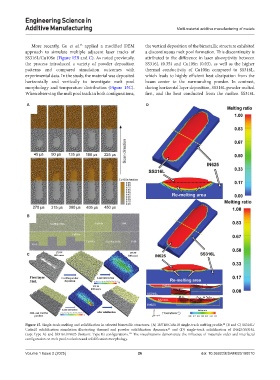
              More recently, Gu  et al.  applied a modified DEM   the vertical deposition of the bimetallic structure exhibited
                                   23
            approach to simulate multiple adjacent laser tracks of   a discontinuous melt pool formation. This discontinuity is
            SS316L/Cu10Sn (Figure 15B and C). As noted previously,   attributed to the difference in laser absorptivity between
            the process introduced a variety of powder deposition   SS316L (0.35)  and Cu10Sn (0.03),  as well as  the higher
            patterns and compared simulation outcomes with     thermal conductivity of Cu10Sn compared to SS316L,
            experimental data. In the study, the material was deposited   which leads to highly efficient heat dissipation from the
            horizontally and vertically  to investigate  melt pool   beam center to the surrounding powder. In contrast,
            morphology and temperature distribution (Figure  15C).   during horizontal layer deposition, SS316L powder melted
            When observing the melt pool track in both configurations,   first, and the heat conducted from the molten SS316L

            A                                                  D


            B


            C


            Figure 15. Single-track melting and solidification in selected bimetallic structures. (A) IN718/CuSn10 single-track melting profile;  (B and C) SS316L/
                                                                                                20
            CuSn10  solidification  simulation  illustrating  thermal  and  powder  solidification  dynamics;   and  (D)  single-track  solidification  of  IN625/SS316L
                                                                         23
            (top: Type-A) and SS316L/IN625 (bottom: Type-B) configurations.  The visualizations demonstrate the influence of materials order and interfacial
                                                        132
            configuration on melt pool evolution and solidification morphology.
            Volume 1 Issue 2 (2025)                         26                         doi: 10.36922/ESAM025180010

