


Page 49 - ESAM-1-2
P. 49
Engineering Science in
            Additive Manufacturing                                          Multi-material additive manufacturing of metals


                         A                                   B


                         C                                         D


                         E


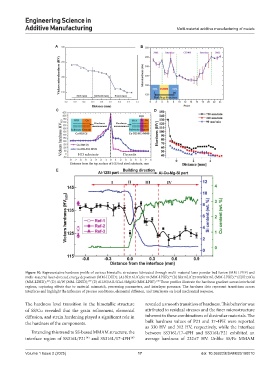
            Figure 10. Representative hardness profile of various bimetallic structures fabricated through multi-material laser powder bed fusion (MM-LPBF) and
            multi-material laser-directed energy deposition (MM-LDED): (A) SS316L/CuSn10 (MM-LPBF);  (B) SS316L/C25400/SS316L (MM-LPBF);  (C)H13/Cu
                                                                                                     56
                                                                         58
                     167
                                                                    172
            (MM-LDED);  (D) Al/W (MM- LDED);  (E) Al12Si/Al3.5Cu1.5Mg1Si (MM-LPBF).  These profiles illustrate the hardness gradient across interfacial
                                       177
            regions,  capturing  effects due  to  material  mismatch,  processing  parameters,  and  interlayer  presence. The  hardness  data represent  transitions  across
            interfaces and highlight the influence of process conditions, elemental diffusion, and interlayers on local mechanical response.
            The hardness level transition in the bimetallic structure   revealed a smooth transition of hardness. This behavior was
            of SS/Cu revealed that the grain refinement, elemental   attributed to residual stresses and the finer microstructure
            diffusion, and strain hardening played a significant role in   inherent to these combinations of dissimilar materials. The
            the hardness of the components.                    bulk hardness values of P21 and 17-4PH were reported
                                                               as 330 HV and 312 HV, respectively, while the interface
              Extending this trend to SS-based MMAM structure, the   between  SS316L/17-4PH  and  SS316L/P21  exhibited  an
            interface region of SS316L/P21  and SS316L/17-4PH    average hardness of 232±7 HV. Unlike SS/Fe MMAM
                                     141
                                                         147
            Volume 1 Issue 2 (2025)                         17                         doi: 10.36922/ESAM025180010

