


Page 80 - ESAM-1-4
P. 80
Engineering Science in
            Additive Manufacturing                                                TwinPrint: Dual-arm robotic bioprinting


            In this work, we address the latter challenge by advancing   2.2. System description
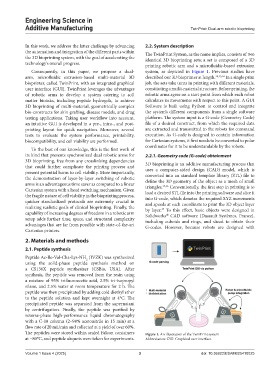
            the automation and integration of the different parts within   The TwinPrint System, as the name implies, consists of two
            the 3D bioprinting system, with the goal of accelerating the   identical 3D bioprinting sets; a set is composed of a 3D
            technology’s overall progress.                     printing robotic arm and a microfluidic-based extrusion
              Consequently,  in  this  paper,  we  propose  a  dual-  system, as depicted in  Figure  1. Previous studies have
            arm, microfluidic extrusion-based multi-material 3D   described our 3D bioprinter at length. 20,23,24  In a single print
            bioprinter, called TwinPrint, with an integrated graphical   job, the sets take turns in printing with different materials,
            user interface (GUI). TwinPrint leverages the advantages   constituting a multi-material structure. Before printing, the
            of robotic arms to develop a system catering to soft   robotic arms agree on a start point from which each robot
            matter bioinks, including peptide hydrogels, to achieve   calculates its movements with respect to this point. A GUI
            3D bioprinting of multi-material, geometrically complex   Software is built using Python to control and integrate
            bio-constructs for skin grafting, disease models, and drug   the system’s different components from a single software
            testing applications. Taking user workflow into account,   platform. The system input is a G-code (Geometry Code)
            an intuitive GUI is developed in a pre-, intra-, and post-  file of a desired construct, from which the required data
            printing layout for quick navigation. Moreover, several   are extracted and transmitted to the robots for command
            tests to evaluate the system performance, printability,   execution. As G-code is designed to contain information
            biocompatibility, and cell viability are performed.  for Cartesian systems, it first needs to be converted to polar
                                                               coordinates for it to be understandable by the robots.
              To the best of our knowledge, this is the first work of
            its kind that presents synchronized dual robotic arms for   2.2.1. Geometry code (G-code) obtainment
            3D bioprinting, free from any crosslinking dependencies
            that could further complicate the printing process and   3D bioprinting is an additive manufacturing process that
            present potential harm to cell viability. More importantly,   uses  a  computer-aided  design  (CAD)  model,  which  is
                                                               converted into an standard template library (STL) file to
            the demonstration of layer-by-layer switching of robotic   define the 3D geometry of the object as a mesh of small
            arms is an advantageous time saver as compared to a linear   35,36
            Cartesian system with a head switching mechanism. Given   triangles.   Conventionally, the first step in printing is to
                                                               load a desired STL file into the printing software and slice it
            the fragile nature of cell viability in the bioprinting process,   into G-code, which denotes the required XYZ movements
            quicker standardized protocols are extremely crucial in   and speeds at each coordinate to print the 3D object layer
            realizing realistic goals of clinical bioprinting. Finally, the   by layer.  To this effect, basic objects were designed in
                                                                      37
            capability of increasing degrees of freedom in a robotic arm   Solidworks   CAD  software  (Dassault  Systèmes,  France),
                                                                        ®
            setup adds further time, space, and structural complexity   including cuboids and rings, and sliced to obtain their
            advantages that are far from possible with state-of-the-art   G-codes. However, because robots are designed with
            Cartesian printers.

            2. Materials and methods
            2.1. Peptide synthesis

            Peptide Ac-Ile-Val-Cha-Lys-NH  (IVZK) was synthesized
                                      2
            using the solid-phase peptide synthesis method on
            a CS136X peptide synthesizer (CSBio, USA). After
            synthesis, the peptide was removed from the resin using
            a mixture of 95% trifluoroacetic acid, 2.5% tri-isopropyl
            silane, and 2.5% water at room temperature for 2 h. The
            peptide was then precipitated by adding cold diethyl ether
            to the peptide solution and kept overnight at 4°C. The
            precipitated peptide was separated from the supernatant
            by centrifugation. Finally, the peptide was purified by
            reverse-phase high-performance liquid chromatography
            with a C-18 column (2–98% acetonitrile in 15 min) at a
            flow rate of 20 mL/min and collected at a yield of over 60%.
            The peptides were stored within sealed Falcon containers   Figure 1. An illustration of the TwinPrint system
            at −80°C, and peptide aliquots were taken for experiments.  Abbreviation: GUI: Graphical user interface.


            Volume 1 Issue 4 (2025)                         3                          doi: 10.36922/ESAM025410025

