


Page 83 - ESAM-1-4
P. 83
Engineering Science in
            Additive Manufacturing                                                TwinPrint: Dual-arm robotic bioprinting


            cells (BM-MSCs). The HL60 and BM-MSCs cell lines were   Confocal Microscope, Germany) was used to observe
            supplied by ATCC (USA) and Professor Abdalla Awidi   and evaluate cells within the printed constructs. Human
            (Cell Therapy Center, University of Jordan, Amman,   BM-MSCs stained with CMFDA Dye were observed using
            Jordan),  respectively.  Human  BM-MSCs  were  cultured   492 nm excitation and 517 nm emission filters. HL-60 cells
            and maintained, as described before. Briefly, the cells were   stained  with  5-chloromethyl  tetraphenyl-p-xylylene
                                                    2
                                            3
            cultured at a seeding density of 4×10   cells/cm ; when   (CMTPX) dye were observed using 577 nm excitation and
            cultures reached 80% confluence, the cells were subcultured   602 nm emission filters. Z-stack images were obtained to
            using 0.25% trypsin. Cells in passages 4–8 were used in the   evaluate the 3D distribution of cells within the printed cell-
            bioprinting  experiments.  Human  BM-MSCs  cells  were   laden constructs.
            maintained in  α-modified minimum essential medium
            (α-MEM) supplemented with 10% mesenchymal stem     3. Results and discussion
            cell–qualified fetal bovine serum (FBS), 2 mM L-glutamine,   3.1. TwinPrint system
            and 1% penicillin/streptomycin (GIBCO, ThermoFisher,
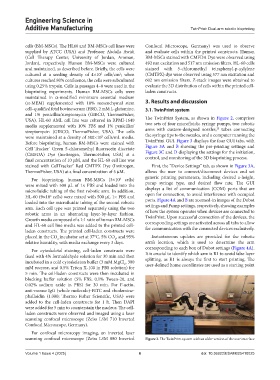
            USA).  HL-60 AML  cell  line  was  cultured  in  RPMI-1640   The TwinPrint System, as shown in  Figure  2, comprises
            media supplemented with 10% FBS and 1% penicillin/  two sets of four microfluidic syringe pumps, two robotic
                                                                                             23
            streptomycin (GIBCO, ThermoFisher, USA). The cells   arms with custom-designed nozzles,  tubes connecting
            were maintained at a density of 500×10  cells/mL media.   the syringe tips to the nozzles, and a computer running the
                                            3
            Before bioprinting, human BM-MSCs were stained with   TwinPrint GUI. Figure 3 displays the four GUI tabs, with
            Cell Tracker  Green 5-chloromethyl fluorescein diacetate   Figure  3A  and B showing the pre-printing settings and
                      ™
            (CMFDA) Dye (Invitrogen, ThermoFisher, USA) at a   Figure 3C and D displaying the settings for the initiation,
            final concentration of 10 µM, and the HL-60 cell line was   control, and monitoring of the 3D bioprinting process.
            stained with CellTracker  Red CMTPX Dye (Invitrogen,   First, the “Device Settings” tab, as shown in Figure 3A,
                                ™
            ThermoFisher, USA) at a final concentration of 5 µM.  allows the user to connect/disconnect devices and set
              For bioprinting, human BM-MSCs (3×10   cells)    generic printing parameters, including desired z-height,
                                                    6
            were mixed with 500 µL of 1× PBS and loaded into the   pump syringe type, and desired flow rate. The GUI
            microfluidic tubing of the first robotic arm. In addition,   displays a list of communication (COM) ports that are
            HL-60 (9×10  cells) were mixed with 500 µL 1× PBS and   open for connection, to avoid interference with occupied
                      6
            loaded into the microfluidic tubing of the second robotic   ports. Figure 4A and B are zoomed-in images of the Dobot
                                                               settings and Pump settings, respectively, showing examples
            arm. Each cell type was printed separately using the two
            robotic arms in an alternating layer-by-layer fashion.   of how the system operates when devices are connected to
            Growth media composed of a 1:1 ratio of human BM-MSCs   TwinPrint. Upon successful connection of the devices, the
            and HL-60 cell line media was added to the printed cell-  corresponding settings are activated across all tabs to allow
            laden constructs. The printed cell-laden constructs were   for communication with the connected devices exclusively.
            placed in the CO  incubator set at 37°C, 5% CO , and 95%   Instantaneous updates are provided for the robotic
                                                  2
                         2
            relative humidity, with media exchange every 3 days.  arm’s  location, which  is  used  to determine  the  arm
                                                               corresponding to each box of Dobot settings (Figure 4A).
              For cytoskeletal staining, cell-laden constructs were
            fixed with 4% formaldehyde solution for 30 min and then   It is crucial to identify which arm is R1 to avoid false layer
                                                               splitting, as R1 is always the first to start printing. The
            incubated in a cold cytoskeleton buffer (3 mM MgCl , 300   user-defined home coordinates are used as a starting point
                                                      2
            mM sucrose, and 0.5% Triton X-100 in PBS solution) for
            5 min. The cell-laden constructs were then incubated in
            blocking  buffer solution (5% FBS, 0.1% Tween-20,  and
            0.02% sodium azide in PBS) for 30  min. For F-actin,
            anti-mouse IgG (whole molecule)-FITC and rhodamine-
            phalloidin (1:300; Thermo Fisher Scientific, USA) were
            added to the cell-laden constructs for 1  h. Then DAPI
            were added for 5 min to counterstain the nucleus. The cell-
            laden constructs were observed and imaged using a laser
            scanning confocal microscope (Zeiss LSM 710 Inverted
            Confocal Microscope, Germany).
              For confocal microscopy imaging, an inverted laser
            scanning confocal microscope (Zeiss LSM 880 Inverted   Figure 2. The TwinPrint system with an older version of the user interface


            Volume 1 Issue 4 (2025)                         6                          doi: 10.36922/ESAM025410025

