


Page 88 - ESAM-1-4
P. 88
Engineering Science in
            Additive Manufacturing                                                TwinPrint: Dual-arm robotic bioprinting


                         A                                 B


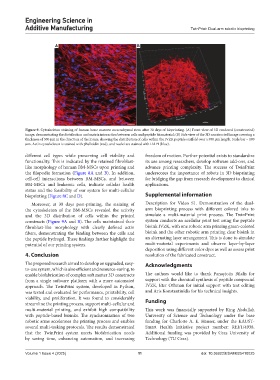
            Figure 9. Cytoskeleton staining of human bone marrow mesenchymal stem after 30 days of bioprinting. (A) Front view of 3D rendered (constructed)
            image, demonstrating the distribution and matrix interaction between cells and peptide biomaterial; (B) Side view of the 3D constructed image covering a
            thickness of 500 µm in the direction of the Z axis, showing the distribution of cells within the IVZK peptide scaffold over a 500 µm length. Scale bar = 100
            µm. Actin cytoskeleton is stained with phalloidin (red), and nuclei are stained with DAPI (blue).
            different  cell  types  while  preserving  cell  viability  and   freedom of motion. Further potential exists to standardize
            functionality. This is indicated by the retained fibroblast-  its use among researchers, develop software add-ons, and
            like morphology of human BM-MSCs upon printing and   advance printing complexity. The success of TwinPrint
            the filopodia formation (Figure  8A  and B). In addition,   underscores the importance of robots in 3D bioprinting
            cell-cell interactions between BM-MSCs, and between   for bridging the gap from research development to clinical
            BM-MSCs and leukemic cells, indicate cellular health   applications.
            status and the feasibility of our system for multi-cellular
            bioprinting (Figure 8C and D).                     Supplemental information
              Moreover, at 30  days post-printing, the staining of   Description for Video S1. Demonstration of the dual-
            the cytoskeleton of the BM-MSCs revealed the activity   arm bioprinting process with different colored inks to
            and the 3D distribution of cells within the printed   simulate a multi-material print process. The TwinPrint
            constructs (Figure 9A and B). The cells maintained their   system conducts an acellular print test using the peptide
            fibroblast-like morphology with clearly defined actin   bioink IVZK, with one robotic arm printing green-colored
            fibers, demonstrating the binding between the cells and   bioink and the other robotic arm printing clear bioink in
            the peptide hydrogel. These findings further highlight the   an alternating layer arrangement. This is done to simulate
            potential of our printing system.                  multi-material experiments and observe layer-by-layer
                                                               deposition using different color dyes as well as assess print
            4. Conclusion                                      resolution of the fabricated construct.
            The proposed research aimed to develop an upgraded, easy-  Acknowledgments
            to-use system, which is also efficient and resource-saving, to
            enable biofabrication of complex soft matter 3D constructs   The authors would like to thank Panayiotis Bilalis for
            from a single software platform with a more automated   support with the chemical synthesis of peptide compound
            approach. The TwinPrint system, developed in Python,   IVZK, Eter Othman for initial support with text editing
            was tested and evaluated for performance, printability, cell   and Aris Konstantinidis for his technical insights.
            viability, and proliferation.  It was found to considerably   Funding
            streamline the printing process, support multi-cellular and
            multi-material printing, and exhibit high compatibility   This work was financially supported by King Abdullah
            with peptide-based bioinks. The synchronization of two   University of Science and Technology under the base
            robotic arms accelerates the printing process and enables   funding for Charlotte A. E. Hauser, under the KAUST-
            several multi-tasking protocols. The results demonstrated   Smart Health Initiative project number: REI/1/4938.
            that the TwinPrint system meets biofabrication needs   Additional funding was provided by Graz University of
            by saving time, enhancing automation, and increasing   Technology (TU Graz).


            Volume 1 Issue 4 (2025)                         11                         doi: 10.36922/ESAM025410025

