


Page 86 - ESAM-1-4
P. 86
Engineering Science in
            Additive Manufacturing                                                TwinPrint: Dual-arm robotic bioprinting


            ballpoint pens were used to determine: (i) Parsing with
            respect to two arms, and (ii) setting of global points.
            While the  parsing process  was found  to  match  the
            previous two modes, it was noted that there was a position
            inaccuracy when each arm would return to the set global
            position. Since the global point coordinates are received
            as feedback from the arm about its current location
            in the 3D space, it was noticed that when the arm was
            returned to the initial setpoint, it was slightly off from
            the specified point with a deviation <1 mm. This could
            be due to mechanical constraints of the arm. Several
            models of the Dobot  Magician were cross-tested, and
                             ®
            similar results were found. However, it is worth noting   Figure  6. Estimated errors in flow rate by SmartFlo and TwinPrint
                                                               software
            that the line thickness of soft matter bioink is generally
            >1  mm, as compared to the 0.5  mm line thickness of
            a fine-tip ballpoint pen. Thus, it was deduced that the   layers approach was used to observe the interaction of
            accuracy  achieved  was  suitable  for  the  3D  bioprinting   both arms in processing commands sequentially, avoiding
            requirements in our scope.                         collision, and recalling start/stop positions.
              To  validate  layer  allocation  for  each  robot,  several   Several trials were performed to resolve bugs in the code,
            combinations  of  layer  splitting  were  tested  for  objects   which initially caused R2 to repeatedly “forget” its start
            of  various layer  heights. Some combinations required   position. Another issue faced was the timeout of the robots
            alternate layering, while others required sequential   due to extended wait periods in between commands. This
            layering (where R1 prints X number of layers and R2 prints   was resolved by adding a minimal movement command
            Y number of layers, one after the other). The tests were all   where R1 would move slightly while in wait position, as R2
            found to pass successfully, with both robots able to print   completed its layer, and vice versa.
            their allocated layers as specified by the user.
                                                                 For system performance evaluation, the TwinPrint
            3.3. Pump accuracy test                            system was used for 3D bioprinting of an acellular 3D
                                                               construct. A seven-layer cuboid of 10 × 10 × 1.4mm  was
                                                                                                         3
            A pump accuracy test was run with three pumps for a range   loaded and parsed by the software. Alternating layers were
            of 4 flow rates (20, 50, 100, and 200 µL/min) to compare   assigned to each robot by splitting them singularly. Pumps
            the accuracy of TwinPrint with its default SmartFlo ®   were set to 60  µL/min and 20  µL/min for IVZK peptide
            software and determine the error. Multiple pumps were   and 5× PBS, respectively, based on printing parameters
            used to minimize error readings from a single pump.   optimized in previous reports. 23-25  R1 was manually moved
            Each pump was run for the range of selected flow rates,   to a desired start point with a z-height of 0.2 mm from the
            first by issuing a command from the SmartFlo  software,   printbed, and the coordinates were saved using the GUI.
                                                 ®
            and second by TwinPrint. Each test was conducted thrice.   The same was repeated for R2 at the same point. The system
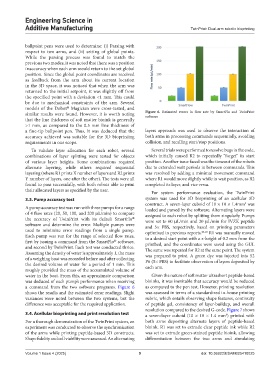
            Assuming the density of water is approximately 1, the mass   was prepared to print. A  green dye was injected into S2
            of a weighing boat was recorded before and after collecting   P6 (5× PBS) to facilitate observation of layers deposited by
            the desired volume of water for a period of 1 min. This   each arm.
            roughly provided the mass of the accumulated volume of
            water in the boat. From this, an approximate comparison   Given the nature of soft matter ultrashort peptide-based
            was deduced of each pump’s performance when receiving   bioinks, it was inevitable that accuracy would be reduced
            a command from the two software programs.  Figure  6   as compared to the pen test. However, printing resolution
            shows the results and the estimated error readings. Slight   was assessed in terms of a standardized in-house printing
            variances were noted between the two systems, but the   rubric, which entails observing shape features, continuity
            difference was acceptable for the required application.  of peptide gel, consistency of layer-buildup, and overall
                                                               resolution compared to the desired G-code. Figure 7 shows
            3.4. Acellular bioprinting and print resolution test  a seven-layer cuboid (10 × 10 × 1.4 mm ) printed with
                                                                                                 3
            For a thorough demonstration of the TwinPrint system, an   both arms depositing alternate layers of peptide-based
            experiment was conducted to observe the synchronization   bioink. R1 was set to extrude clear peptide ink while R2
            of the arms while printing peptide-based 3D constructs.   was set to extrude green-stained peptide bioink, allowing
            Shape fidelity and cell viability were assessed. An alternating   differentiation between the two arms and simulating


            Volume 1 Issue 4 (2025)                         9                          doi: 10.36922/ESAM025410025

