


Page 9 - ESAM-1-4
P. 9
Engineering Science in
            Additive Manufacturing                                                       Experimental statistics in AM


            identifying key factors influencing product reliability and   fitted model, where residuals are the difference between
            enabling informed decision-making based on data-driven   the model prediction of a data point and its true value.
            insights. This paper aims to highlight essential statistical   These tables and companion manuscript are the result of
            techniques beneficial to the AM community, facilitating   an extensive literature search of statistical manuscripts
            the adoption of best practices and improving confidence   and were produced in conversations with different AM
            in AM-produced parts (for detailed discussions of specific   experts. The designs are presented from the simplest to the
            techniques). 26                                    most complex. Our underlying expectation is that as the

              Statistics is a larger field than can possibly be covered   statistical sophistication of AM advances, more complex
            here, but this broad overview highlights some of the   designs will be used.
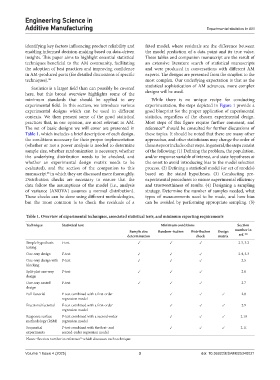
            minimum standards that should be applied to any      While  there  is  no  unique  recipe  for  conducting
            experimental field. In this section, we introduce various   experimentation, the steps depicted in Figure 1 provide a
            experimental designs which can be used in different   good blueprint for the proper application of experimental
            contexts. We then present some of the good statistical   statistics,  regardless of the chosen  experimental  design.
            practices that, in our opinion, are most relevant in AM.   Most steps of this figure require further comment, and
                                                                      26
            The  set  of basic  designs  we  will  cover  are  presented  in   reference  should be consulted for further discussions of
            Table 1, which includes a brief description of each design,   these topics. It should be noted that there are many other
            the conditions necessary for their proper implementation   approaches, and other statisticians may change the order of
            (whether or not a power analysis is needed to determine   these steps or include other steps. In general, the steps consist
            sample size, whether randomization is necessary, whether   of the following: (1) Defining the problem, the population,
            the underlying distribution needs to be checked, and   and/or response variable of interest, and state hypotheses at
            whether an experimental design matrix needs to be   the onset to avoid introducing bias to the model selection
            evaluated), and the section of the companion to this   process. (2) Defining a statistical model (or set of models)
                     26
            manuscript  in which they are discussed more thoroughly.   based on the stated hypotheses. (3) Conducting pre-
            Distribution checks are necessary to ensure that the   experimental procedures to ensure experimental efficiency
            data follow the assumptions of the model (i.e., analysis   and  trustworthiness  of  results.  (4)  Designing  a  sampling
            of variance [ANOVA] assumes a normal distribution).   strategy. Determine the number of samples needed, what
            These checks can be done using different methodologies,   types of measurements need to be made, and how bias
            but the most common is to check the residuals of a   can be avoided by performing appropriate sampling. (5)


            Table 1. Overview of experimental techniques, associated statistical tests, and minimum reporting requirements
            Technique      Statistical test                          Minimum conditions               Section
                                                        Sample size   Random‑ization  Distribution   Design   number in
                                                       determination                check     matrix   ref.  26a
            Simple hypothesis   t-test                      ✓            ✓            ✓               2.3, 3.2
            testing
            One-way design  F-test                          ✓            ✓            ✓               2.4, 3.3
            One-way design with  F-test                     ✓            ✓            ✓                 2.5
            blocking
            Split-plot one-way   F-test                     ✓            ✓            ✓                 2.6
            design
            One-way nested   F-test                         ✓            ✓            ✓                 2.7
            design
            Full factorial  F-test combined with a first-order           ✓            ✓         ✓       2.8
                           regression model
            Fractional factorial  F-test combined with a first-order     ✓            ✓         ✓       2.9
                           regression model
            Response surface   F-test combined with a second-order       ✓            ✓         ✓      2.10
            methodology (RSM)  regression model
            Sequential     F-test combined with the first- and           ✓            ✓         ✓      2.11
            experiments    second-order regression model
            Notes:  Section number in reference  which discusses each technique.
                 a
                                   26
            Volume 1 Issue 4 (2025)                         3                          doi: 10.36922/ESAM025340021

