


Page 101 - GHES-1-1
P. 101
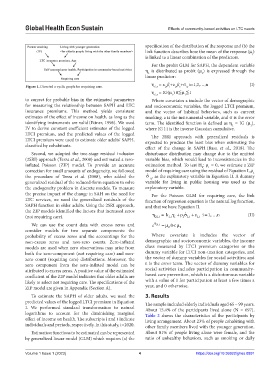
Global Health Econ Sustain                                   Effects of community-based activities on LTC needs


                                                               specification of the distribution of the response and (b) the
                                                               link function describes how the mean of the response (μ)
                                                                                                            j
                                                               is linked to a linear combination of the predictors.
                                                                 For the probit GLM for SAPH, the dependent variable
                                                               η  is distributed as probit (μ ) is expressed through the
                                                                                       1
                                                                1
                                                               linear predictor:
            Figure 1. Directed a cyclic graph for requiring care.  η  = x β +z β +σ  i=1,2,…,n             (I)
                                                                       i,t i
                                                                                i,t
                                                                   1i,t
                                                                           i,t z
                                                                 η  = IG(μ ) 0≦μ ≦1
                                                                          1
                                                                   1i,t
                                                                               1
            to correct for probable bias in the estimated parameters   Where covariates x include the vector of demographic
            for measuring the relationship between SAPH and LTC   and socioeconomic variables, the logged LTCI premium,
            insurance premiums. This method yields consistent   and the vector of habitual behaviors, such as current
            estimates of the effect of income on health, as long as the   smoking. z is the instrumental variable, and σ is the error
            identifying instruments are valid (Ettner, 1996). We used   term. The identified function is defined as η  = IG (μ ),

                                                                                                            1
                                                                                                    1
                                                                       .
            IV to derive constant coefficient estimates of the logged   where IG ( ) is the inverse Gaussian cumulative.
            LTCI premium, and the predicted values of the logged   The  2SRI approach  with generalized  residuals is
            LTCI premium were used to estimate older adults’ SAPH,   expected to produce the least bias when estimating the
            classified by cohabitants.                         effect of the change in SAPH (Basu  et al., 2018). The

              Second,  we  adopted  the two-stage residual  inclusion   disturbance distribution may change due to the omitted
            (2SRI) approach (Terza et al., 2008) and estimated a zero-  variable bias, which would lead to inconsistencies in the
            inflated Poisson (ZIP) model. To provide an accurate   estimation method. To test H : ρ  = 0, we estimate a ZIP
                                                                                          1
                                                                                       0
            correction for small amounts of endogeneity, we followed   model of requiring care using the residual of Equation I, ρ 1
            the procedure of Terza  et al. (2008), who added the   ˆ σ , as the explanatory variable in Equation II. A dummy
                                                                 i,t
            generalized residual of the reduced-form equation to solve   variable for living in public housing was used as the
            the endogeneity problem in discrete models. To measure   explanatory variable.
            the precise impact of the change in SAH on the need for   For the Poisson GLM for requiring care, the link
            LTC services, we used the generalized residuals of the   function of regression equation is the natural log function,
            SAPH function in older adults. Using the 2SRI approach,   and that we have Equation II.
            the ZIP models identified the factors that increased zeros
                                                                                ˆ σ + ε
            (not requiring care).                                 η  2i,t  =   k γ + ρ 1 i,t  i,t  i 1,= … ,n  (II)
                                                                         i,t i
              We  can  use  the  count  data  with  excess  zeros  and   e  η 2 it,  = µ 0< µ
            consider models for two separate components: the             2   2
            probability of  excess  zeros  and the accountings  for  the   Where covariate k includes the vector of
            non-excess zeros and non-zero counts. Zero-inflated   demographic and socioeconomic variables, the income
            models are used when zero observations may arise from   class measured by LTCI premium categories or the
            both the zero-component (not requiring care) and non-  dummy variable for LTCI non-taxation categories, and
            zero count (requiring care) distributions. Moreover, the   the vector of dummy variables for social activities; and
            zero component from the zero-inflated model can be   ε is the error term. The vector of dummy variables for
            attributed to excess zeros. A positive value of the estimated   social  activities  includes  participation in  community-
            coefficient of the ZIP model indicates that older adults are   based care prevention, which is a dichotomous variable
            likely to select not requiring care. The specifications of the   with a value of 1 for participation at least a few times a
            ZIP model are given in Appendix (Section A).       year, and 0 otherwise.
              To estimate the SAPH of older adults, we used the   3. Results
            predicted values of the logged LTCI premium in Equation   The sample included elderly individuals aged 65 – 99 years.
            I.  We  performed  standard  transformation  to  natural   About 15.4% of the participants lived alone (N = 697).
            logarithms to account for the diminishing marginal   Table  2 shows the characteristics of the participants by
            effect of income on health. The subscripts i and t indicate   living arrangement. About 23% of people cohabiting with
            individuals and periods, respectively. In this study, t=2020.  other family members lived with the younger generation.
              Estimation functions to be estimated can be represented   About 81% of people living alone were female, and the
            by generalized linear model (GLM) which requires (a) the   ratio  of  unhealthy behaviors,  such as  smoking or  daily


            Volume 1 Issue 1 (2023)                         4                        https://doi.org/10.36922/ghes.0891

