


Page 89 - GHES-1-2
P. 89
Global Health Econ Sustain                                      Non-communicable diseases household survey


            2.3. Statistical analysis                          one NCD condition. The overall prevalence of these five

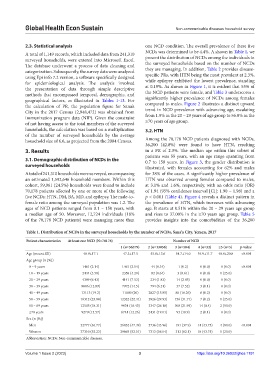
            A total of 1,149 records, which included data from 241,310   NCDs was determined to be 4.4%. A shown in Table 1, we
            surveyed households, were entered into Microsoft Excel.   present the distribution of NCDs among the individuals in
            The database underwent a process of data cleaning and   the surveyed households based on the number of NCDs
            categorization. Subsequently, the survey data were analyzed   they are managing. In addition, Table 2 provides disease-
            using Epi info 7.2 version, a software specifically designed   specific PRs, with HTN being the most prevalent at 2.3%,
            for epidemiological analysis. The analysis involved   while epilepsy exhibited the lowest prevalence, standing
            the presentation of data through simple descriptive   at 0.19%. As shown in Figure 1, it is evident that 53% of
            methods that encompassed temporal, demographic, and   the NCD patients were female, and Table 3 underscores a
            geographical factors, as illustrated in  Tables  1-13. For   significantly higher prevalence of NCDs among females
            the calculation of PR, the population figure for Sana’a   compared to males. Figure 2 illustrates a distinct upward
            City in the 2017 Census (2,948,472)  was obtained from   trend in NCD prevalence with advancing age, escalating
            immunization program data (NIP). Given the constraint   from 1.9% in the 20 – 29 years of age group to 56.0% in the
            of not having access to the total members of the surveyed   ≥70 years of age group.
            households, the calculation was based on a multiplication   3.2. HTN
            of the number of surveyed households by the average
            household size of 6.6, as projected from the 2004 Census.  Among the 70,178 NCD patients diagnosed with NCDs,
                                                               36,200  (42.8%)  were found to have HTN,  resulting
            3. Results                                         in a PR of 2.3%. The median age within this subset of
                                                               patients was 55 years, with an age range spanning from
            3.1. Demographic distribution of NCDs in the       0.7 to 150  years. In  Figure  3, the gender distribution is
            surveyed households                                illustrated, with females accounting for 62% and males
            A total of 241,310 households were surveyed, encompassing   for 38% of the cases. A significantly higher prevalence of
            an estimated 1,592,646 household members. Within this   HTN was observed among females compared to males,
            cohort, 59,061 (24.5%) households were found to include   at 3.1%  and  1.6%, respectively, with  an odds ratio (OR)
            70,178 patients affected by one or more of the following   of 1.94 (95% confidence interval [CI]: 1.90 – 1.98) and a
            five NCDs: HTN, DM, BA, MD, and epilepsy. The male-to-  p < 0.001 (Table 4). Figure 4 reveals a distinct pattern in
            female ratio among the surveyed population was 1.2. The   the prevalence of HTN, which increases with advancing
            ages of NCD patients ranged from 0.1 – 150 years, with   age. It starts at 0.51% within the 20 – 29 years age group
            a median age of 50. Moreover, 12,724 individuals (18%   and rises to 37.00% in the ≥70 years age group. Table 5
            of the 70,178 NCD patients) were managing more than   provides insights into the comorbidities  of the 36,200

            Table 1. Distribution of NCDs in the surveyed households by the number of NCDs, Sana’a City, Yemen, 2017
            Patient characteristics  At least one NCD (N=70178)            Number of NCD
                                                    1 (n=56579)  2 (n=13058)  3 (n=504)  4 (n=32)  ≥5 (n=5)  p‑value
            Age (mean±SD)            48.9±17.1       47.3±17.5   55.8±13.6  54.7±14.0  54.9±11.7  48.0±20.8  <0.001
            Age group (n [%])
             0 – 9 years            1461 (2.14)      1461 (2.14)  44 (0.34)  1 (0.2)  0 (0.0)  0 (0.0)  <0.001
             10 – 19 years          2444 (3.58)      2358 (4.29)  82 (0.64)  3 (0.61)  0 (0.0)  1 (25.0)
             20 – 29 years          4389 (6.43)      4141 (7.53)  234 (1.83)  14 (2.85)  0 (0.0)  0 (0.0)
             30 – 39 years          8806 (12.89)     7972 (14.5)  794 (6.21)  37 (7.52)  3 (0.1)  0 (0.0)
             40 – 49 years          13113 (19.2)     11000 (20)  2027 (15.85)  80 (16.26)  6 (0.2)  0 (0.0)
             50 – 59 years         16312 (23.88)    12322 (22.41)  3826 (29.93)  156 (31.71)  7 (0.2)  1 (25.0)
             60 – 69 years         12505 (18.31)     9034 (16.43)  3347 (26.18)  108 (21.95)  14 (0.4)  2 (50.0)
             ≥70 years              9270 (13.57)     6744 (12.26)  2431 (19.01)  93 (18.9)  2 (0.1)  0 (0.0)
            Sex (n [%])
             Men                   32777 (46.77)    26832 (47.49)  5736 (43.96)  191 (37.9)  14 (43.75)  4 (80.0)  <0.001
             Women                 37310 (53.23)    29665 (52.51)  7313 (56.04)  313 (62.1)  18 (43.75)  1 (20.0)
            Abbreviation: NCDs: Non-communicable diseases.


            Volume 1 Issue 2 (2023)                         3                        https://doi.org/10.36922/ghes.1191

