


Page 93 - GHES-1-2
P. 93
Global Health Econ Sustain                                      Non-communicable diseases household survey


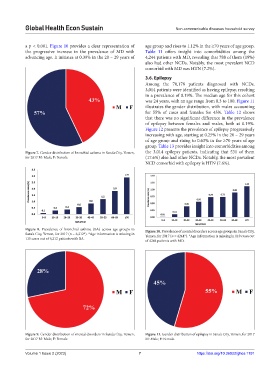
            a p < 0.001. Figure 10 provides a clear representation of   age group and rises to 1.12% in the ≥70 years of age group.
            the  progressive  increase in  the  prevalence  of  MD  with   Table  11 offers insight into comorbidities among the
            advancing age. It initiates at 0.39% in the 20 – 29 years of   4,244 patients with MD, revealing that 788 of them (19%)
                                                               also had other NCDs. Notably, the most prevalent NCD
                                                               comorbid with MD was HTN (7.2%).

                                                               3.6. Epilepsy
                                                               Among the 70,178  patients diagnosed with NCDs,
                                                               3,014 patients were identified as having epilepsy, resulting
                                                               in a prevalence of 0.19%. The median age for this cohort
                                                               was 24 years, with an age range from 0.3 to 100. Figure 11
                                                               illustrates the gender distribution, with males accounting
                                                               for 55% of cases and females for 45%.  Table  12  shows
                                                               that there was no significant difference in the prevalence
                                                               of epilepsy between females and males, both at 0.19%.
                                                               Figure 12 presents the prevalence of epilepsy progressively
                                                               increasing with age, starting at 0.25% in the 20 – 29 years
                                                               of age group and rising to 0.63% in the ≥70 years of age
                                                               group. Table 13 provides insight into comorbidities among
            Figure 7. Gender distribution of bronchial asthma in Sana’a City, Yemen,   the 3,014 epilepsy patients, indicating that 531 of them
            for 2017 M: Male; F: Female.                       (17.6%) also had other NCDs. Notably, the most prevalent
                                                               NCD comorbid with epilepsy is HTN (7.6%).


            Figure  8.  Prevalence of bronchial asthma (BA) across age groups in   Figure 10. Prevalence of mental disorders across age groups in Sana’a City,
            Sana’a City, Yemen, for 2017 (n = 6,212*). *Age information is missing in   Yemen, for 2017 (n = 4244*). *Age information is missing in 110 cases out
            135 cases out of 6,212 patients with BA.           of 4244 patients with MD.


            Figure 9. Gender distribution of mental disorders in Sana’a City, Yemen,   Figure 11. Gender distribution of epilepsy in Sana’a City, Yemen, for 2017
            for 2017 M: Male; F: Female.                       M: Male; F: Female.


            Volume 1 Issue 2 (2023)                         7                        https://doi.org/10.36922/ghes.1191

