


Page 118 - GHES-2-1
P. 118
Global Health Econ Sustain                                Prolonged impact of health-care expenditure on poverty


              This study focuses on 20 low-  and middle-income   standards, and budget monitoring to underscore the
            countries and investigates the data from 2000 to 2018,   importance of health spending, placing it among their highest
            Appendices 1  and  2. This research rigorously applies   priorities. This observation prompts a crucial question: What
            the  autoregressive  distributed  lag  (ARDL)  bounds   measures are essential to ensure protection from poverty,
            methodology to scrutinize  the connection between the   and does increased spending on health effectively balance
            poverty rate and healthcare service expenditures within   the interconnected factors to achieve optimal equilibrium?
            the specified countries, period of time, and factors.   The primary objective of this study is to ascertain the
            Acknowledging the diverse definitions and measurements   impact of health expenditures on the spread of poverty
            of global poverty, the World Bank’s 2021 indicators   in low-  and middle-income countries and explore the
            highlight the monetary threshold of a country’s national   existence of a long-term relationship between these
            poverty line. This threshold represents the point at which   two variables. To address key questions related to the
            meeting an individual’s minimum basic needs becomes   topic, this study aimed to gauge the extent to which
            challenging, considering the country’s economic and social   health expenditure influences poverty and scrutinize the
            conditions. Moreover, this study recognizes the dynamic   assumption that health expenditure serves as a catalyst for
            nature of poverty as countries develop. The study aims to   an increase in the poverty ratio in low- and middle-income
            determine the impact of spending on health as a criterion
            for measuring the optimal use of resources.        countries. The research presents a valuable contribution by
                                                               revealing an additional determinant of health financing
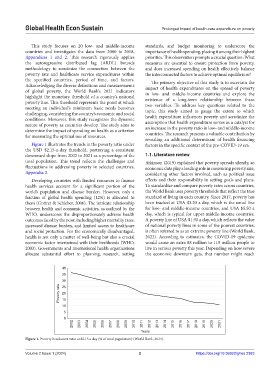
              Figure 1 illustrates the trends in the poverty ratio under   factors in the specific context of the pre-COVID-19 era.
            the  USD $2.15-a-day threshold, portraying  a consistent
            downward slope from 2002 to 2021 as a percentage of the   1.1. Literature review
            total population. This trend reflects the challenges and   Atkinson (2019) explained that poverty spreads silently, so
            fluctuations in addressing poverty in selected countries,   economic data play a leading role in measuring poverty size,
            Appendix 3.                                        considering other factors involved, such as political issue
              Developing countries with limited resources to finance   effects and their responsibility in setting goals and plans.
            health services account for a significant portion of the   To standardize and compare poverty rates across countries,
            world’s population and disease burden. However, only a   the World Bank uses poverty thresholds that reflect the true
            fraction of global health spending (12%) is allocated to   standard of living in each country. Since 2017, poverty has
            them (Gottret & Schieber, 2006). The intricate relationship   been tracked at USA $3.20 a day, which is the usual line
            between health and economic activities, as outlined by the   for low- and middle-income countries, and USA $5.50 a
            WHO, underscores the disproportionately adverse health   day, which is typical for upper-middle-income countries.
            outcomes faced by the poor, including higher mortality rates,   A poverty line of USA $1.90 a day, which reflects the value
            increased disease burden, and limited access to healthcare   of national poverty lines in some of the poorest countries,
            and social protection. For the economically disadvantaged,   is often referred to as an extreme poverty line (World Bank,
            health is not only a matter of well-being but also a crucial   2022). According to estimates, the COVID-19 epidemic
            economic factor intertwined with their livelihoods (WHO,   would cause an extra 88 million to 115 million people to
            2003). Governments and international health organizations   live in serious poverty this year. Depending on how severe
            allocate substantial effort to planning, research, setting   the economic downturn gets, that number might reach


                           40
                           35
                           30
                          Poverty rate  20
                           25
                           15
                           10
                            5
                            0
                                2002  2003  2004  2005  2006  2007  2008  2009  2010  2011  2012  2013  2014  2015  2016  2017  2018  2019  2020  2021
                                                             Years
            Figure 1. Poverty headcount ratio at $2.15 a day (% of total population) (World Bank, 2024).


            Volume 2 Issue 1 (2024)                         2                        https://doi.org/10.36922/ghes.2383

