


Page 120 - GHES-2-1
P. 120
Global Health Econ Sustain Prolonged impact of health-care expenditure on poverty
P = t 0 + i HE + ε 1 (III) of adjusting X and Y individually toward long-run
t
t
t
equilibrium.
Z t−1 = P t−1 − 0 + i HE t−1 (IV) 2.3. ARDL long-run test
These equations are used in the study to analyze both As stated by Pesaran et al. (1997) and Pesaran and Shin
short- and long-run causality between poverty (Pt) and (1999), the ARDL is an ordinary model based on the
health-care expenditure (HEt) and incorporate lagged ordinary least squares (OLS) regression that applies to
values to capture dynamic relationships. The error terms both non-stationary time series and time series with a
(μt and ε1) account for unobserved factors or measurement mixed order of integration. The ARDL model approach
errors in the models. The variables β and δ represent the estimation process is represented as (Shrestha & Bhatta,
i
i
short-run coefficients, while φ and φ symbolize the ARDL 2018):
1
2
long-run coefficients, and µ refers to the disturbance
t
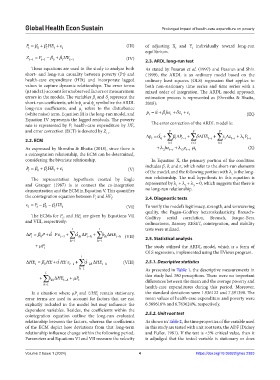
(white noise) term. Equation III is the long-run model, and p =α ′ + β i he +δ z + e t (IX)
t
t
t
Equation IV represents the lagged residuals. The poverty
rate is represented by P, health-care expenditure by HE, The error correction of the ARDL model is:
and error correction (ECT) is denoted by Z . p =α ′ p t i − ∑ p
p
t-1
z
+
2.2. ECM t 0 + ∑ β i P + δ HE ti − ∑ i ti− + λ 1 P ti−
i=1 i =1 i=1
As expressed by Shrestha & Bhatta (2018), since there is + λ 2 he t ti− +λ i3 z t i− µ t (X)
a cointegration relationship, the ECM can be determined,
considering the bivariate relationship. In Equation X, the primary portion of the condition
P = β 0 + β i HE + ε 1 (V) includes β, δ, and ε, which refer to the short-run elements
t
t
of the model, and the following portion with λ is the long-
s
The representation hypothesis created by Engle run relationship. The null hypothesis in this equation is
and Granger (1987) is to connect the co-integration represented by λ + λ + λ = 0, which suggests that there is
2
3
1
demonstration and the ECM in Equation V. This quantifies no long-run relationship.
the cointegration equation between P and HE : t 2.4. Diagnostic tests
t
ε = P t − 0 − i HE t (VI) To verify the model’s legitimacy, strength, and unwavering
1
quality, the Pagan-Godfrey heteroskedasticity, Breusch-
The ECMs for P , and HE are given by Equations VII Godfrey serial correlation, Breusch, Jarque-Bera
t
t
and VIII, respectively: ordinariness, Ramsey RESET, cointegration, and stability
1 1 tests were utilized.
+
P = β 0 P +α ′ P t− ∑ α ′ ih P th− ∑ b ih HE th− (VII)
+
t
1
h−1 h −1 2.5. Statistical analysis
+ P t The study utilized the ARDL model, which is a form of
OLS regression, implemented using the EViews program.
1
HE = β 0 HE +α ′ HE t− ∑ α ′ 2 h HE t h− (VIII) 2.5.1. Descriptive statistics
+
t
1
h−1 As presented in Table 1, the descriptive measurements in
1
+ ∑ 2 h HE t h + P t this study had 380 perceptions. There were no important
b
−
differences between the mean and the average poverty and
h−1
health-care expenditures during this period. Moreover,
In a situation where μP and UHE remain stationary, the standard deviations were 1.936122 and 7.391398. The
t
t
error terms are used to account for factors that are not mean values of health-care expenditure and poverty were
explicitly included in the model but may influence the 6.369616% and 6.763624%, respectively.
dependent variables. Besides, the coefficients within the
cointegration equation outline the long-run evaluated 2.5.2. Unit root test
relationship between the factors, whereas the coefficients As shown in Table 2, the time properties of the variable used
of the ECM depict how deviations from that long-term in this study are tested with unit root tests, the ADF (Dickey
relationship influence change within the following period. and Fuller, 1981). If the test is <5% critical value, then it
Parameters and Equations VI and VII measure the velocity is adjudged that the tested variable is stationary or does
Volume 2 Issue 1 (2024) 4 https://doi.org/10.36922/ghes.2383

