


Page 121 - GHES-2-1
P. 121
Global Health Econ Sustain Prolonged impact of health-care expenditure on poverty
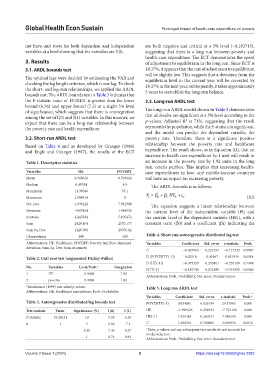
not have unit roots for both dependent and independent are both negative and critical at a 5% level (−0.183745),
variables at a level showing that the variables are I(0). suggesting that there is a long run between poverty and
health-care expenditure. The ECT demonstrates the speed
3. Results of adjustment to equilibrium in the long run. Since ECT is
3.1. ARDL bounds test 18.37%, it appears that the rate of adjustment to equilibrium
will be slightly low. This suggests that a deviation from the
The optimal lags were decided by estimating the VAR and equilibrium level in the current year will be corrected by
checking the lag length criterion, which is one lag. To check 18.37% in the next year; subsequently, it takes approximately
the short- and log-run relationships, we applied the ARDL 5 years to reestablish the long-run balance.
bounds test. The ARDL bounds test in Table 3 indicates that
the F-statistic value of 19.20431 is greater than the lower 3.3. Long-run ARDL test
bound (6.56) and upper bound (7.3) at a slight 5% level
of significance, which suggests that there is cointegration The long-run ARDL model shown in Table 5 demonstrates
among the set of I(0) and I(1) variables. In this manner, we that all results are significant at a 5% level according to the
2
expect that there can be a long-run relationship between p-values. Adjusted R is 71%, suggesting that the result
the poverty rate and health expenditure. represents the population, while the F-statistic is significant,
and the model can predict the dependent variable, the
3.2. Short-run ARDL test poverty rate. Therefore, there is a significant positive
Based on Table 4 and as developed by Granger (1986) relationship between the poverty rate and healthcare
and Engle and Granger (1987), the results of the ECT expenditure. The result shows, as in Equation XII, that an
increase in health care expenditure by 1 unit will result in
Table 1. Descriptive statistics an increase in the poverty rate by 1.92 units in the long
run, ceteris paribus. This implies that increasing health-
Variables HE POVERT care expenditures in low- and middle-income countries
Mean 6.369616 6.763624 will have an impact on increasing poverty.
Median 6.49534 4.3 The ARDL formula is as follows:
Maximum 11.39546 35.1
Minimum 1.909314 0 P = t 0 + i HE + ε 1 (XI)
t
Std. Dev. 1.936122 7.391398 The equation suggests a linear relationship between
Skewness −0.05164 1.544536 the current level of the independent variable (Pt) and
Kurtosis 2.247934 5.105472 the current level of the dependent variable (HEt), with a
Sum 2420.454 2570.177 constant term (β0) and a coefficient (βi) indicating the
Sum Sq. Dev. 1420.708 20705.82
Observations 380 380 Table 4. Short‑run autoregressive distributed lag test
Abbreviations: HE: Healthcare; POVERT: Poverty; Std. Dev.: Standard Variables Coefficient Std. error t‑statistic Prob.
deviation; Sum. Sq. Dev: Sum of squares
C −0.025965 0.221293 −0.117332 0.9067
Table 2. Unit root test (augmented Dickey‑Fuller) D (POVERTY(-1)) 0.02516 0.05567 0.451949 0.6516
D (HE(-1)) −0.075359 0.295401 −0.255109 0.7988
No. Variables Level/Prob.* Integration
ECT(-1) −0.183745 0.031889 −5.761992 0.0000
1 HE 0.0008 I (0)
Abbreviations: Prob.: Probability; Std. error: Standard error
2 poverty 0.0000 I (0)
*Mackinnon (1999) one-sided p-values. Table 5. Long‑run ARDL test
Abbreviations: HE: Healthcare expenditure; Prob.: Probability
Variables Coefficient Std. error t‑statistic Prob.*
Table 3. Autoregressive distributed lag bounds test POVERTY(-1) 0.834081 0.028199 29.57863 0.000
Test statistic Value Significance (%) I (0) I (1) HE −1.999626 0.258913 −7.723166 0.000
F-statistic 19.20431 10 5.59 6.26 HE(-1) 1.921485 0.260343 7.380596 0.000
k 1 5 6.56 7.3 C 1.600764 0.780885 2.049936 0.0411
2.50 7.46 8.27 *Note: p-values and any subsequent test results do not account for
model selection.
1 8.74 9.63
Abbreviations: Prob.: Probability; Std. error: Standard error
Volume 2 Issue 1 (2024) 5 https://doi.org/10.36922/ghes.2383

