


Page 123 - GHES-2-1
P. 123
Global Health Econ Sustain                                Prolonged impact of health-care expenditure on poverty


            Table 7. Unrestricted cointegration rank test      people living in poverty, with the normalized poverty gap
                                                               increasing from 19.13% to 22.69%. Smaller families, longer
            Hypothesized   Eigenvalue  Trace   0.05 critical   Prob.**  hospital stays, use of private health facilities, and chronic
            no. of CE (s)         statistic  value             illness increased the likelihood of poverty as a result of
            None *       0.075795  43.59105  15.49471  0.000   OOP medical expenses. This study clarifies the intricacies
            At most 1 *  0.03673  14.03294  3.841466  0.0002   of healthcare spending and how it affects poverty. The
            *Denotes rejection of the hypothesis at the 0.05 level.  study, which focuses on India, highlights the need for
            **Mackinnon-Haug-Michelis (1999) p-values.         tailored financial protection systems by highlighting the
            Abbreviation: Prob.: Probability
                                                               impoverishing impacts of OOP health costs. The wider view
                                                               of your analysis, which considers low- and middle-income
             60                                                nations, emphasizes the necessity for balanced policy

             40                                                interventions in health-care finance while highlighting
                                                               the possible unexpected repercussions of rising health-
             20                                                care spending on poverty levels. Conversely, Wagstaff et al.
              0                                                (2003) concentrated on how health-care spending affects
                                                               poverty in low-  and middle-income nations. The study
            -20
                                                               evaluated the relationship between poverty levels and OOP
            -40                                                health costs using data from household surveys. According
                                                               to their results, households can become impoverished
            -60
                   50    100  150   200   250  300   350       because of high healthcare costs, especially in nations
                                                               with inadequate social safety nets or no access to health
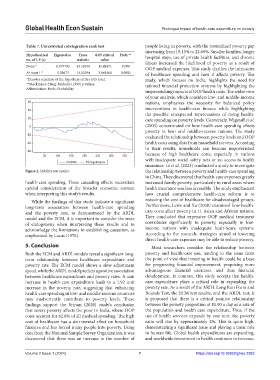
                             CUSUM   5% Significance
                                                               insurance. Li et al. (2023) conducted a study to investigate
            Figure 2. Stability test results.                  the relationship between poverty and health-care spending
                                                               in China. They discovered that health-care expenses greatly
            health-care spending. These cascading effects necessitate   increased family poverty, particularly in rural areas where
            careful consideration of the broader economic context   health insurance was less accessible. The study emphasized
            when interpreting this study’s results.            how crucial comprehensive health-care reform is to
              While the findings of this study indicate a significant   reducing the cost of healthcare for disadvantaged groups.
            long-term association between health-care spending   Furthermore, Leive and Xu (2008) examined how health-
            and  the  poverty  rate,  as  demonstrated by  the  ARDL   care costs affect poverty in 11 Asian and African nations.
            model and the ECM, it is important to consider the issue   They concluded that expensive OOP medical treatment
            of endogeneity when interpreting these results and to   contributes significantly to poverty, especially in low-
            acknowledge the limitations in establishing causation, as   income nations with inadequate healt-hcare systems.
            emphasized by Lucas (1976).                        According to the research, strategies aimed at lowering
                                                               direct health-care expenses may be able to reduce poverty.
            5. Conclusion                                        Most researchers consider the relationship between

            Both the ECM and ARDL models reveal a significant long-  poverty and health-care use, tending to the issue from
            term relationship between healthcare expenditure and   the point of view that investing in health could be a base
            poverty rate. The ECM model shows a slow adjustment   for progressing financial improvement, proposing more
            speed, while the ARDL model predicts a positive association   advantageous  financial  exercises,  and  thus  financial
            between healthcare expenditure and poverty rates. A unit   development. In contrast, this study accepts that health-
            increase in health-care expenditure leads to a 1.92 unit   care expenditure plays a critical role in expanding the
            increase in the poverty rate, suggesting that enhancing   poverty rate. As a result of the ARDL Long Run Form and
            health-care spending in low- and middle-income countries   Bounds Test, the ECM test results, and the ARDL test, it
            may inadvertently contribute to poverty levels. These   is proposed that there is a critical positive relationship
            findings support the Sriram (2020) study’s conclusion   between the poverty proportion at $1.90 a day as a rate of
            that severe poverty affects the poor in India, where OOP   the population and health care expenditure. Thus, if the
            costs account for 62.6% of all medical spending. The high   use of health services expands by one unit, the poverty
            cost of healthcare has a detrimental effect on household   ratio  will  rise  by  approximately  2%.  This  is  quite  high,
            finances and has forced many people into poverty. Using   demonstrating a significant issue and playing a basic role
            data from the National Sample Survey Organization, it was   in human life. Global health expenditures are expanding,
            discovered that there was an increase in the number of   and worldwide investment in health continues to increase.


            Volume 2 Issue 1 (2024)                         7                        https://doi.org/10.36922/ghes.2383

