


Page 122 - GHES-2-1
P. 122
Global Health Econ Sustain                                Prolonged impact of health-care expenditure on poverty


            impact of HEt on Pt. The error term (ε1) accounts for   slow adjustment speed toward equilibrium, signifying that
            factors not included in the model.                 deviations from the equilibrium level will take almost
            Pt=1.600764+1.921485⋅HE t−1               (XII)    five years to be rectified. Moreover, the short-run ARDL
                                                               model, with significant outcomes at a 5% level according to
            3.4. Diagnostic tests                              p-values, yields an adjusted R-squared of 71%, suggesting
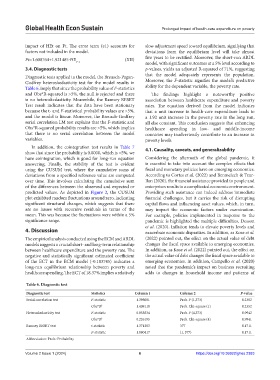
            Diagnostic tests applied to the model, the Breusch-Pagan-  that the model adequately represents the population.
            Godfrey heteroskedasticity test for the model results in   Moreover,  the  F-statistic signifies the  model’s  predictive
            Table 6, imply that since the probability value of F-statistics   ability for the dependent variable, the poverty rate.
            and Obs*R-squared is >5%, the null is rejected and there   The findings highlight a noteworthy positive
            is no heteroskedasticity. Meanwhile, the Ramsey RESET   association between healthcare expenditure and poverty
            Test  result indicates that the data have been  stationary   rates. The equation derived from the model indicates
            because the t- and F-statistical probability values are >5%,   that a unit increase in health-care expenditure leads to
            and the model is linear. Moreover, the Breusch-Godfrey   a 1.92 unit increase in the poverty rate in the long run,
            serial correlation LM test explains that the F-statistic and   all else constant. This conclusion suggests that enhancing
            Obs*R-squared probability results are >5%, which implies   healthcare spending in low-  and middle-income
            that there is no serial correlation between the model   countries may inadvertently contribute to an increase in
            variables.                                         poverty levels.
              In addition, the cointegration test results in  Table 7   4.1. Causality, caveats, and generalizability
            show that since the probability is 0.0000, which is <5%, we
            have cointegration, which is good for long-run equation   Considering the aftermath of the global pandemic, it
            answering. Finally, the stability of the test is evident   is essential to take into account the complex effects that
            using the CUSUM test, where the cumulative sums of   fiscal and monetary policies have on emerging economies.
            deviations from a specified reference value are computed   According to Cortes et al. (2022) and Benmelech & Tzur-
            over time. This involves calculating the cumulative sum   Ilan (2020), the financial assistance provided to people and
            of the differences between the observed and expected or   enterprises results in a complicated economic environment.
            predicted values. As depicted in  Figure  2, the CUSUM   Providing such assistance can indeed address immediate
            plot exhibited random fluctuations around zero, indicating   financial challenges, but it carries the risk of disrupting
            significant structural  changes,  which suggests that  there   capital flows and influencing asset values, which, in turn,
            are no issues with recursive residuals in terms of the   may impact the economic factors under examination.
            mean. This was because the fluctuations were within a 5%   For example, policies implemented in response to the
            significance range.                                pandemic is highlighted the multiple difficulties, Desson
                                                               et al. (2020). Inflation tends to elevate poverty levels and
            4. Discussion                                      exacerbate economic disparities. In addition, as Kose et al.

            The empirical analysis conducted using the ECM and ARDL   (2022) pointed out, the effect on the actual value of debt
            models suggests a crucial short- and long-term relationship   changes the fiscal space available to emerging economies.
            between healthcare expenditure and the poverty rate. The   In addition, as Kose et al. (2022) pointed out, the effect on
            negative and statistically significant estimated coefficient   the actual value of debt changes the fiscal space available to
            of the ECT in the ECM model (-0.183745) indicates a   emerging economies. In addition, Campello et al. (2020)
            long-run equilibrium relationship between poverty and   noted that the pandemic’s impact on business recruiting
            healthcare spending. The ECT of 18.37% implies a relatively   adds to changes in household income and patterns of

            Table 6. Diagnostic test
            Diagnostic test             Statistics        Column 1            Column 2                 P‑value
            Serial correlation test     F-statistic        1.395681           Prob. F (1,373)           0.2382
                                        Obs*R 2            1.409118           Prob. Chi-square (1)      0.2352
            Heteroskedasticity test     F-statistic        0.055834           Prob. F (4,373)           0.9942
                                        Obs*R 2            0.226195           Prob. Chi-square (4)      0.9941
            Ramsey RESET test           t-statistic        1.371283           377                       0.1711
                                        F-statistic        1.880417           (1, 377)                  0.1711
            Abbreviation: Prob.: Probability


            Volume 2 Issue 1 (2024)                         6                        https://doi.org/10.36922/ghes.2383

