


Page 194 - GHES-2-1
P. 194
Global Health Econ Sustain                                            Antimicrobial resistance control model


            A  good internal and external quality assurance scheme   antimicrobial treatment targeted at the most probable
            should be drafted for a fully-equipped, functional clinical   causative microorganism. This could be broad-spectrum
            microbiology laboratory to implement a thorough AMS in   antimicrobials (Vera and Luther, 2015) that drive up AMR
            any institutions. External certification from registered bodies,   and many other untoward consequences, such as increased
            such as the International Organization for Standardization,   health-care costs, adverse drug events, and sometimes
            should be fostered, while the Stepwise Laboratory   antibiotic-associated  diarrhea.  The  recommendations
            Improvement  Process Towards  Accreditation  (SLIPTA)   for the guideline should be based on local susceptibility
            (World  Health Organization Regional office for  Africa,   data, available scientific evidence or expert opinion when
            2015) and Strengthening Laboratory Management Toward   evidence is lacking.
            Accreditation (SLMTA) are viable accreditation processes   A drug formulary can be easily adapted from the available
            readily available in LMICs that can be implemented in all   antimicrobial guidelines or the nation’s existing drug
            clinical microbiology laboratories to ensure quality.  formulary which can reduce the use of antimicrobials not
            3. Strategies of clinical microbiology in          available in such drug formulary for the health institution.
            AMS                                                The AWaRe list of the World Health Organization can guide
                                                               decisions on the essential drug lists in health facilities. This
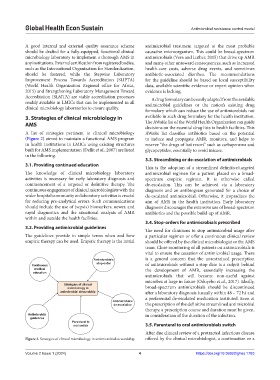
            A list of strategies pertinent to clinical microbiology   AWaRe list classifies antibiotics based on the potential
            (Figure 2) aimed to maintain a functional AMS program   to induce and propagate AMR, monitors, and helps to
            in health institutions in LMICs using existing structures   reserve “the drugs of last resort” such as carbapenems and
            built for AMS implementation (Dellit et al., 2007) are listed   glycopeptides, essentially to avoid misuse.
            in the following.
                                                               3.3. Streamlining or de-escalation of antimicrobials
            3.1. Providing continued education
                                                               This is the adoption of a streamlined definitive/targeted
            The knowledge of clinical microbiology laboratory   antimicrobial regimen for a patient placed on a broad-
            activities is necessary for early laboratory diagnosis and   spectrum empiric regimen. It is otherwise called
            commencement of a targeted or definitive therapy. The   de-escalation. This can be achieved via a laboratory
            continuous engagement of clinical microbiologists with the   diagnosis and an antibiogram generated for a choice of
            wider hospital community on laboratory activities is crucial   de-escalated antimicrobial. Otherwise, it jeopardizes the
            for reducing pre-analytical errors. Such communications   aim of AMS in the health institution. Early laboratory
            should include the use of (sepsis) biomarkers, newer, and   diagnosis discourages the extensive use of broad-spectrum
            rapid diagnostics and the situational analysis of AMR   antibiotics and the possible build-up of AMR.
            within and outside the health facilities.
                                                               3.4. Stop-orders for antimicrobials prescribed
            3.2. Providing antimicrobial guidelines
                                                               The need for clinicians to stop antimicrobial usage after
            The guidelines provide in simple terms when and how   a particular regimen or offer a continuous clinical review
            empiric therapy can be used. Empiric therapy is the initial   should be offered by the clinical microbiologist or the AMS
                                                               team. Close monitoring of all patients on antimicrobials is
                                                               vital to ensure the cessation of antimicrobial usage. There
                                         Antimicrobials        is a general concern that the unrestrained prescription
                                          stop-order           of antimicrobials without a stop date is a culprit behind
               Continuous
                medical                                        the  development  of AMR, essentially  increasing  the
               education
                                                               antimicrobials  that  will  become  non-useful  against
                                                               microbes at large in future (Oduyebo et al., 2017). Ideally,
                            Strategies of clinical
                              microbiology in                  broad-spectrum antimicrobials should be discontinued
                           antimicrobial stewardship           after a laboratory diagnosis (usually within 48 – 72 h) and
                                                               a preferential de-escalated medication instituted. Even at
                                                 Antimicrobials
                                                 de-escalation  the prescription of the definitive streamlined antimicrobial
                                                               therapy, a prescription course and duration must be given,
             Antimicrobial                                     in consideration of the duration of the infection.
              guidelines
                                Parenteral to
                                oral switch                    3.5. Parenteral to oral antimicrobials switch
                                                               After due clinical review of a protracted infectious disease
            Figure 2. Strategies of clinical microbiology in antimicrobial stewardship  offered by the clinical microbiologist, a continuation or a


            Volume 2 Issue 1 (2024)                         4                        https://doi.org/10.36922/ghes.1783

