


Page 192 - GHES-2-1
P. 192
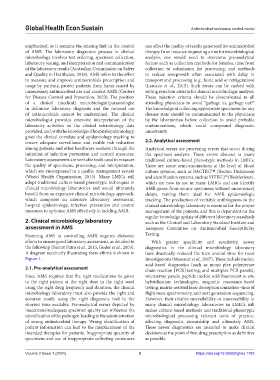
Global Health Econ Sustain Antimicrobial resistance control model
emphasized, as it remains the missing link in the control can affect the quality of results generated for antimicrobial
of AMR. The laboratory diagnostic process in clinical therapy. In an instance requesting urine for microbiological
microbiology involves test ordering, specimen collection, analysis, one would need to overcome pre-analytical
laboratory testing, and interpretation and communication factors such as collection methods for females, time from
of the laboratory results (Australian Commission on Safety collection to submission for processing, and methods
and Quality in Healthcare, 2018). AMS refers to the effort to reduce overgrowth often associated with delay in
to measure and improve antimicrobials prescription and transport and processing (e.g., boric acid or refrigeration)
usage by patients, protect patients from harm caused by (Larocco et al., 2015). Such errors can be curbed with
unnecessary antimicrobial use and combat AMR (Centers setting rejection criteria for clinical microbiologic analysis.
for Disease Control and Prevention, 2023). The position These rejection criteria should be disseminated to all
of a clinical (medical) microbiologist/parasitologist attending physicians to avoid “garbage in, garbage out!”
in definitive laboratory diagnosis and the rational use The knowledge of collecting appropriate specimens for any
of antimicrobials cannot be undermined. The clinical disease state should be communicated to the physicians
microbiologist provides extensive interpretation of the by the laboratorian before collection to avoid probable
laboratory activities on the clinical microbiology data contaminations, which could compound diagnostic
provided, and, with the knowledge of hospital epidemiology, uncertainty.
gives the clinical correlate and epidemiology tracking to
ensure adequate surveillance and enable risk reduction 2.2. Analytical assessment
among patients and other healthcare workers through the Analytical errors are processing errors that occur during
initiation of infection prevention and control measures. the specimen analysis. These errors abound in many
Laboratory assessments are veritable tools used to measure traditional culture-based phenotypic methods in LMICs.
the quality of specimens, processing, and interpretation, There are some semi-automations at the level of blood
which are encompassed in a quality management system culture systems, such as BACTEC™ (Becton Dickinson)
(World Health Organization, 2015). Many LMICs still and identification systems, such as VITEK 2 (BioMerieux),
adopt traditional culture-based phenotypic techniques in which are now in use in many LMICs and can identify
clinical microbiology laboratories and would ultimately AMR genes from source specimens without unnecessary
benefit from an expansive clinical microbiology approach, delays, making them ideal for AMR epidemiologic
which comprises an intensive laboratory assessment, tracking. The production of veritable antibiograms in the
hospital epidemiology, infection prevention and control clinical microbiology laboratory is essential for the proper
measures to optimize AMS effectively in tackling AMR. management of the patients, and this is dependent on the
regular knowledge update of different laboratory standards
2. Clinical microbiology laboratory such as the Clinical and Laboratory Standard Institute and
assessment in AMS European Committee on Antimicrobial Susceptibility
Fostering AMS in controlling AMR requires elaborate Testing.
efforts to ensure good laboratory assessment, as detailed in With greater specificity and sensitivity, newer
the following (Saurav Patra et al., 2013, Guder et al., 2003). diagnostics in the clinical microbiology laboratory
A diagram succinctly illustrating these efforts is shown in have drastically reduced the turn around time for most
Figure 1. investigations (Messacar et al., 2017). These include nucleic
acid-based diagnostics (such as mono plex polymerase
2.1. Pre-analytical assessment chain reaction [PCR] testing, and multiplex PCR panels),
Since AMS requires that the right medications be given microarray panels, peptide nucleic acid fluorescent in situ
to the right patient at the right dose in the right ward hybridization technologies, magnetic resonance-based
using the right drug frequency and duration, the clinical testing, matrix-assisted laser desorption ionization–time of
microbiology laboratory must also provide the right and flight mass spectrometry, and next generation sequencing.
accurate result, using the right diagnostic tool in the However, their relative unavailability or inaccessibility in
shortest time available. Pre-analytical errors depicted by many clinical microbiology laboratories in LMICs still
inaccurate/inadequate specimen quality can influence the makes culture-based methods and traditional phenotypic
identification of the pathogen, leading to the administration microbiological processing relevant tools of practice,
of wrong antimicrobial therapy. Wrong identification of affecting diagnostic stewardship and ultimately AMS.
patient information can lead to the misplacement of the These newer diagnostics are intended to make clinical
intended therapies for patients. Inappropriate quantity of decisions at the point of first drug prescription as definitive
specimens and use of inappropriate collecting containers as possible.
Volume 2 Issue 1 (2024) 2 https://doi.org/10.36922/ghes.1783

