


Page 73 - GHES-2-1
P. 73
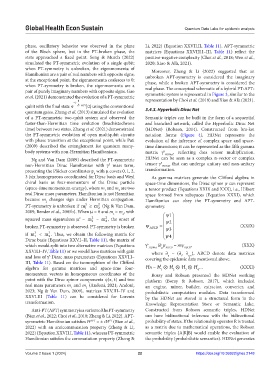
Global Health Econ Sustain Quantum Data Lake for epidemic analysis
phase, oscillatory behavior was observed in the plane Li, 2022) (Equation XXVII.II, Table 11). APT-symmetric
of the Bloch sphere, but in the PT-broken phase, the matrices (Equations XXVIII.I–III, Table 11) reflect the
state approached a fixed point. Song & Murch (2022) positive-negative complexity (Choi et al., 2018; Wen et al.,
simulated the PT-symmetric evolution of a single qubit; 2020; Xiao & Alù, 2021).
when PT-symmetry is unbroken, the eigenmomenta of Moreover, Zheng & Li (2022) suggested that an
Hamiltonian are a pair of real numbers with opposite signs; unbroken APT-symmetry is considered the imaginary
at the exceptional point, the eigenmomenta coalesces to 0; phase, while a broken APT-symmetry is considered the
when PT-symmetry is broken, the eigenmomenta are a real phase. The conceptual schematic of a hybrid PT-APT-
pair of purely imaginary numbers with opposite signs. Gao
et al. (2021) demonstrated the evolution of a PT-symmetric symmetric system is represented in Figure 3, similar to the
t representation by Choi et al. (2018) and Xiao & Alù (2021).
−i
qubit with the final state e ħ HPT |0⟩ using the conventional
quantum gates. Zheng et al. (2013) simulated the evolution 3.4.3. Hyperbolic Dirac Net
of a PT-symmetric two-qubit system and observed the Semantic triples can be built in the form of a sequential
faster-than-Hermitian time evolution (brachistochrone and branched network, called the Hyperbolic Dirac Net
time) between two states. Zhang et al. (2021) demonstrated (HDNet) (Robson, 2014). Constructed from bra-ket
the PT-symmetric evolution of open multiqubit circuits notation forms (Figure 4), HDNet represents the
with phase transition at the exceptional point, while Pati evolution of the inference of complex space and space-
(2009) described the entanglement for quantum many- time dimensions; it can be represented as the fifth gamma
body systems with non-Hermitian Hamiltonians. matrix γ 5 HDNet , reflecting data tensor multiplication.
Ng and Van Dam (2009) described the PT-symmetric HDNet can be seen as a complex n-vector or complex
non-Hermitian Dirac Hamiltonian with γ mass term, tensor γ 5 HDNet that can undergo unitary and non-unitary
5
presenting the Plücker coordinates p with μ covers 0, 1, 2, transformation.
μ
3 (six homogeneous coordinates) for Dirac basis and Weyl As gamma matrices generate the Clifford algebra in
chiral basis as four-momentum of the Dirac particle space-time dimensions, the Dirac spinor ψ can represent
(space-time momentum-energy), where m and m are two a tensor product (Equations XXIX and XXX), i.e., Hilbert
2
1
real Dirac mass parameters. Hamiltonian is not Hermitian space formed from subspaces (Equation XXXI), which
because m changes sign under Hermitian conjugation. Hamiltonian can obey the PT-symmetry and APT-
2
2
2
PT-symmetry is unbroken if m ≥ m (Ng & Van Dam, symmetry.
2
1
2009; Bender et al., 2005b). When μ = 0 and m = m , with
1 2 1
2
2
squared mass eigenvalues μ = m – m , the onset of 2
2
1
2
broken PT-symmetry is observed. PT-symmetry is broken ABCD = 3 (XXIX)
2
2
if m < m . Thus, we obtain the following matrix for 4
2
1
Dirac basis (Equations XXV.I–II, Table 11), the matrix of
which would split into two alternative matrices (Equations γ 5 HDNet i∂ ψ ABCD = mψ ABCD , (XXX)
µ
XXV.III–IV, Table 11) or we would have matrices with gain where ∂ = (∂ , ∂ ), ABCD denote data matrices
µ
and loss of γ Dirac mass parameters (Equations XXVI.I– covering the epidemic data mentioned above.
xyz
t
5
III, Table 11). Based on the isomorphism of the Clifford
algebra for gamma matrices and space-time four- Hn = H ⊗ H ⊗ H ⊗ H … (XXXI)
3
4
2
1
momentum vectors in homogeneous coordinates of the Boray and Robson presented the HDNet working
point with the Dirac spinor components ψ(x, t) and two platform (Boray & Robson, 2017), which included
real mass parameters m and m (Andoni, 2021; Andoni, an engine, miner, builder, extractor, converter, and
2
1
2023; Ng & Van Dam, 2009), matrices XXV.III–IV and probabilistic computation modules. Data transformed
XXVI.III (Table 11) can be considered for Lorentz by the HDNet are stored in a structured form in the
transformation. Knowledge Representation Store or Semantic Lake.
Anti-PT (APT) symmetry is a variant of the PT-symmetry Constructed from Robson semantic triples, HDNet
(Bian et al., 2022; Choi et al., 2018; Zheng & Li, 2022). APT- can have bidirectional inference with the bidirectional
symmetric Hamiltonian satisfies H APT = ± iH (Bian et al., probability of states. If the relationship operator R is treated
PT
2022) with an anticommutation property (Zheng & Li, as a matrix due to mathematical operations, the Robson
2022) (Equation XXVII.I, Table 11), whereas PT-symmetric semantic triples ⟨A|R|B⟩ would enable the evaluation of
Hamiltonian satisfies the commutation property (Zheng & the probability (probabilistic semantics). HDNet generates
Volume 2 Issue 1 (2024) 22 https://doi.org/10.36922/ghes.2148

