


Page 112 - GHES-2-2
P. 112
Global Health Econ Sustain                                                     Antenatal care attendance


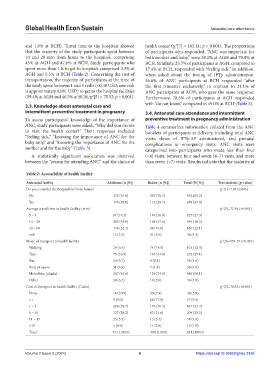
            and 1.8% at BCH). Travel time to the hospitals showed   health center (χ [7] = 105.11; p < 0.001). The proportions
                                                                            2
            that the majority of the study participants spent between   of participants who responded, “ANC was important for
            10 and 29  min from home to the hospitals, comprising   both mother and baby,” were 38.1% at AGH and 70.8% at
            45% at AGH and 47.6% at BCH. Study participants who   BCH. Similarly, 25.7% of participants at AGH, compared to
            spent more than 1 h to get to hospitals comprised 3.3% at   17.4% at BCH, responded with “feeling sick.” In addition,
            AGH and 5.5% at BCH (Table 2). Concerning the cost of   when asked about the timing of IPTp administration,
            transportation, the majority of participants at the time of   46.6% of ANC participants at BCH  responded “after
            the study spent between 1 and 5 cedis (<0.40 USD; one cedi   the first trimester exclusively,” in contrast to 21.1% of
            is approximately 0.081 USD) to get to the hospital facilities   ANC participants at AGH, who gave the same response.
            (59.4% at AGH and 46.3% at BCH; χ [5] = 78.52; p < 0.001).  Furthermore, 78.5% of participants at AGH responded
                                        2
                                                               with “do not know,” compared to 49.0% at BCH (Table 3).
            3.3. Knowledge about antenatal care and
            intermittent preventive treatment in pregnancy     3.4. Antenatal care attendance and intermittent
            To assess participants’ knowledge of the importance of   preventive treatment in pregnancy administration
            ANC, study participants were asked, “Why did you decide   Table 4 summarizes information collated from the ANC
            to visit the health center?” Their responses included   booklets of participants at delivery, including total ANC
            “feeling sick,” “knowing the importance of ANC for the   visits, doses of IPTp-SP administered, and prenatal
            baby only,” and “knowing the importance of ANC for the   complications or emergency visits. ANC visits were
            mother and for the baby” (Table 3).                categorized  into  participants  who  made  less  than  four

              A statistically significant association was observed   (<4) visits, between four and seven (4–7) visits, and more
            between the “reason for attending ANC” and the choice of   than seven (>7) visits. Results indicate that the majority of

            Table 2: Accessibility of health facility

            Antenatal facility                 Adidome (n [%])  Battor (n [%])  Total (N [%])  Test statistic (p‑value)
                                                                                               2
            Do you consider the hospital far from house?                                        χ  (1)=7.84 (0.005)
             No                                  275 (61.0)        267 (70.3)   542 (65.2)
             Yes                                 176 (39.0)        113 (29.7)   289 (34.8)
            Average travel time to health facility (min)                                        χ  (3)=72.49 (<0.001)
                                                                                               2
             5 – 9                                    87 (19.3)     140 (36.8)  227 (27.3)
             10 – 29                             203 (45.0)        181 (47.6)   384 (46.2)
             30 – 60                             146 (32.4)        38 (10.0)    184 (22.1)
             >60                                      15 (3.3)     21 (5.5)        36 (4.3)
            Mode of transport to health facility                                                χ  (9)=154.15 (<0.001)
                                                                                               2
             Walking                                  29 (6.4)     74 (19.5)    103 (12.4)
             Taxi                                     75 (16.6)     167 (44.0)  242 (29.1)
             Bus                                      30 (6.7)     8 (2.1)         38 (4.6)
             Boat or canoe                            31 (6.9)     7 (1.8)         38 (4.6)
             Motorbike (okada)                   287 (63.6)        129 (34.0)   416 (50.1)
             Other                                    30 (6.7)     10 (2.6)        40 (4.8)
                                                                                               2
            Cost of transport to health facility (Cedis)                                        χ  (5)=78.52 (<0.001)
             None                                     18 (3.99)     30 (7.9)       48 (5.8)
             <1                                       9 (2.0)      68 (17.9)       77 (9.3)
             1 – 5                               268 (59.4)        176 (46.3)   444 (53.4)
             6 – 10                              127 (28.2)        82 (21.6)    209 (25.2)
             11 – 15                                  25 (5.5)     13 (3.4)        38 (4.6)
             >15                                      4 (0.9)      11 (2.9)        15 (1.8)
             Total                                451 (100.0)    380 (100.0)      831 (100.0)


            Volume 2 Issue 2 (2024)                         6                        https://doi.org/10.36922/ghes.2336

