


Page 115 - GHES-2-2
P. 115
Global Health Econ Sustain                                                     Antenatal care attendance


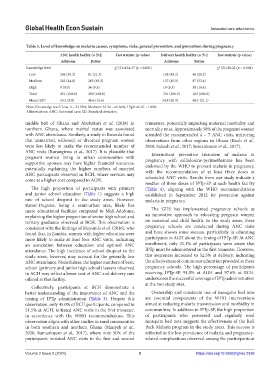
            Table 5. Level of knowledge on malaria causes, symptoms, risks, general prevention, and prevention during pregnancy
                           ANC health facility (n [%])  Test statistic (p‑value)  Delivery health facility (n [%])  Test statistic (p‑value)
                           Adidome      Battor                         Adidome      Battor
                                                   2
                                                                                              2
            Knowledge level                       χ  (2)=124.37 (p < 0.001)                  χ  (2)=26.22 (p < 0.001)
             Low             246 (55.2)    81 (21.3)                    145 (48.2)     46 (28.2)
             Medium          202 (44.8)    263 (69.2)                   137 (45.5)     87 (53.4)
             High            0 (0.0)    36 (9.5)                        19 (6.3)     30 (18.4)
             Total           451 (100.0)    380 (100.0)                 301 (100.0)     163 (100.0)
             Mean (SD)       33.2 (9.8)    46.6 (16.6)                 34.8 (20.0)     48.5 (21.1)
            Note: Knowledge level: Low: 0 – 33.33%; Medium: 33.34 – 66.66%; High: 66.67 – 100%.
            Abbreviations: ANC: Antenatal care; SD: Standard deviation.

            middle belt of Ghana and Abubakari  et al. (2018) in   trimesters, potentially impacting maternal morbidity and
            northern Ghana,  where  marital  status  was associated   mortality rates. Approximately 50% of the pregnant women
            with ANC attendance. Similarly, a study in Rwanda found   attended the recommended 4 – 7 ANC visits, mirroring
            that unmarried, widowed, or divorced pregnant women   observations from other regions in Ghana (Boah  et  al.,
            were less likely to make the recommended number of   2018; Sakeah et al., 2017; Sumankuuro et al., 2017).
            ANC visits (Rurangirwa et al., 2017). It is plausible that   Intermittent preventive treatment of malaria in
            pregnant women living in urban communities with    pregnancy with sulfadoxine-pyrimethamine has been
            supportive spouses may have higher financial resources,   endorsed by the WHO to prevent malaria in pregnancy,
            potentially explaining  the higher  numbers of  married   with the recommendation of at least three doses at
            ANC participants observed in BCH, where services may
            come at a higher cost compared to AGH.             scheduled ANC visits. Results from our study indicate a
                                                               median of three doses of IPTp-SP at each health facility
              The high proportion of participants with primary   (Table 4), aligning with the WHO recommendations
            and junior school education (Table 1) suggests a high   established in September 2012 for protection against
            rate of school dropout in the study areas. However,   malaria in pregnancy.
            Battor-Dugame, being a semi-urban area, likely has
            more educational facilities compared to Mafi-Adidome,   The GHS has implemented pregnancy schools as
            explaining the higher proportion of senior high school and   an innovative approach to educating pregnant women
            tertiary graduates observed at BCH. This observation is   on maternal and child health. In the study areas, these
            consistent with the findings of Muyunda et al. (2016), who   pregnancy schools are conducted during ANC visits
            found that, in Zambia, women with higher education were   and have shown some success, particularly in educating
            more likely to make at least four ANC visits, indicating   participants in AGH about the timing of IPTp-SP. At ANC
            an  association  between education  and  optimal  ANC   enrollment, only 21.1% of participants were aware that
            attendance. The high incidence of school dropout in the   IPTp must be administered in the first trimester. However,
            study areas, however, may account for the generally low   this awareness increased to 52.5% at delivery, indicating
            ANC attendance. Nonetheless, the higher numbers of basic   the effectiveness of continuous education provided at these
            school (primary and junior high school) leavers observed   pregnancy schools.  The high percentage of participants
            in AGH may reflect a lower cost of ANC and delivery care   receiving IPTp-SP, 91.0% at AGH and 97.6% at BCH,
            offered at that facility.                          underscores the successful coverage of IPTp administration
                                                               at the two study sites.
              Collectively, participants at BCH demonstrate a
            better understanding of the importance of ANC and the   Ownership and consistent use of mosquito bed nets
            timing of IPTp administration (Table 3). Despite this   are essential components of the WHO interventions
            observation, only 45.0% of BCH participants, compared to   aimed at reducing malaria transmission and morbidity in
            51.5% at AGH, initiated ANC visits in the first trimester,   communities. In addition to IPTp-SP, the high proportion
            in accordance with the WHO recommendations. This   of participants who possessed and regularly used
            observation aligns with other studies in rural communities   mosquito bed nets suggests the effectiveness of the Roll
            in  both  southern  and northern  Ghana  (Manyeh  et al.,   Back Malaria program in the study areas. This success is
            2020; Sumankuuro  et al., 2017), where only 50% of the   reflected in the low prevalence of malaria and pregnancy-
            participants initiated ANC visits in the first and second   related complications observed among the participants at


            Volume 2 Issue 2 (2024)                         9                        https://doi.org/10.36922/ghes.2336

