


Page 113 - GHES-2-2
P. 113
Global Health Econ Sustain                                                     Antenatal care attendance


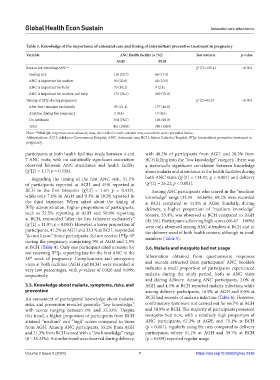
            Table 3. Knowledge of the importance of antenatal care and timing of intermittent preventive treatment in pregnancy
            Variable                                ANC Health facility (n [%])     Test statistic      p‑value
                                                   AGH              BCH
            Reason for attending ANC**                                              χ  (7)=105.11       <0.001
                                                                                     2
             Feeling sick                        116 (25.7)         66 (17.4)
             ANC is important for mother           93 (20.6)        40 (10.5)
             ANC is important for baby             73 (16.2)        9 (2.4)
             ANC is important for mother and baby  172 (38.1)       269 (70.8)
            Timing of IPTp during pregnancy                                         χ  (2)=83.37        <0.001
                                                                                     2
             After first trimester exclusively     95 (21.1)        177 (46.6)
             Anytime during the pregnancy          2 (0.4)          17 (4.5)
             Do not know                         354 (78.5)         186 (49.0)
             Total                                451 (100.0)       380 (100.0)
            Note: **Multiple responses were allowed; thus, the totals for each variable may exceed the sums provided below.
            Abbreviations: AGH: Adidome Government Hospital; ANC: Antenatal care; BCH: Battor Catholic Hospital; IPTp: Intermittent preventive treatment in
            pregnancy.

            participants at both health facilities made between 4 and   with 48.2% of participants from AGH and 28.2% from
            7 ANC visits, with no statistically significant association   BCH falling into the “low knowledge” category. There was
            observed between ANC attendance and health facility   a statistically significant correlation between knowledge
              2
            (χ [2] = 1.17; p = 0.558).                         about malaria and attendance at the health facilities during
                                                                               2
              Regarding  the  timing  of the first  ANC  visit,  51.5%   both ANC visits (χ [2] = 124.37; p < 0.001) and delivery
                                                                 2
            of participants reported at AGH and 45% reported at   (χ [2] = 26.22; p < 0.001).
            BCH  in  the  first  trimester (χ [2]  =  1.67;  p  =  0.433),   Among ANC participants who scored in the “medium
                                      2
            while only 7.6% in AGH and 9.3% in BCH reported in   knowledge” range (33.34 – 66.66%), 69.2% were recorded
            the  third trimester.  When  asked  about  the  timing  of   at BCH compared to 44.8% at AGH. Similarly, during
            IPTp administration, higher proportions of participants,   delivery, a higher proportion of “medium knowledge”
            such as 52.5% reporting at AGH and 50.9% reporting   scorers, 53.4%, was observed at BCH compared to AGH
            at BCH, responded “after the first trimester exclusively”   (45.5%). Participants achieving high scores (66.67 – 100%)
            (χ [2] = 11.97; p = 0.003). However, a lower proportion of   were only observed among ANC attendees at BCH and in
              2
            participants, 41.2% at AGH and 33.1% at BCH, responded   the delivery ward of both health centers, although in small
            “do not know.” Some participants did not receive IPTp-SP   numbers (Table 5).
            during the pregnancy, comprising 9% at AGH and 2.5%
            at BCH (Table 4). Only one participant cited a reason for   3.6. Malaria and mosquito bed net usage
            not receiving IPTp, reporting late for the first ANC in the
            38   week  of  pregnancy.  Complications  and  emergency   Information obtained from questionnaire responses
              th
            visits at both facilities (AGH and BCH) were recorded at   and records extracted from participants’ ANC booklets
            very low percentages, with p-values of 0.026 and 0.099,   indicates a small proportion of participants experienced
            respectively.                                      malaria during the study period, both at ANC visits
                                                               and during delivery. Among ANC participants, 2.0% at
            3.5. Knowledge about malaria, symptoms, risks, and   AGH and 4.5% at BCH reported malaria infection, while
            prevention                                         among delivery participants, 16.9% at AGH and 8.0% at
            An assessment of participants’ knowledge about malaria,   BCH had records of malaria infection (Table 6). However,
            risks, and prevention revealed generally “low knowledge,”   confirmatory tests were not carried out for 66.7% at AGH
            with scores ranging between 0% and 33.33%. Despite   and 58.8% at BCH. The majority of participants possessed
            this trend, a higher proportion of participants from BCH   mosquito bed  nets,  with  a relatively high proportion of
            attained “medium” and “high” scores compared to those   ANC participants, 67.3% at AGH, and 75.1% at BCH
            from AGH. Among ANC participants, 55.2% from AGH   (p < 0.001), regularly using the nets compared to delivery
            and 21.3% from BCH scored with a “low knowledge” range   participants, where 51.1% at AGH and 39.7% at BCH
            (0 – 33.33%). A similar trend was observed during delivery,   (p = 0.039) reported regular usage.


            Volume 2 Issue 2 (2024)                         7                        https://doi.org/10.36922/ghes.2336

