


Page 123 - GHES-2-2
P. 123
Global Health Econ Sustain                                     COVID-19: Mental health in South-South Nigeria


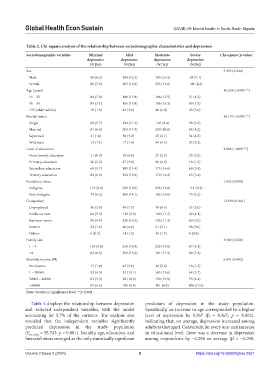
            Table 2. Chi‑square analysis of the relationship between sociodemographic characteristics and depression
            Sociodemographic variables  Minimal       Mild         Moderate       Severe       Chi‑square (p‑value)
                                      depression    depression    depression     depression
                                       (N [%])        (N [%])       (N [%])       (N [%])
            Sex                                                                                    3.323 (0.344)
             Male                      98 (8.2)      194 (16.2)    195 (16.3)       85 (7.1)
             Female                    88 (7.3)      203 (16.9)    235 (19.6)     101 (8.4)
            Age (years)                                                                         36.624 (<0.001**)
             18 – 35                   84 (7.0)      189 (15.8)    186 (15.5)      51 (4.2)
             36 – 55                   85 (7.1)      165 (13.8)    196 (16.3)      90 (7.5)
             >55 (older adults)        18 (1.5)       43 (3.6)      48 (4.0)       45 (3.8)
            Marital status                                                                      36.137 (<0.001**)
             Single                    68 (5.7)      134 (11.2)    101 (8.4)       38 (3.2)
             Married                   81 (6.8)      208 (17.3)    250 (20.8)      98 (8.2)
             Separated                     31 (14)    38 (3.2)      25 (2.1)       54 (4.5)
             Widowed                   13 (1.1)       17 (1.4)      54 (4.5)       25 (2.1)
            Level of education                                                                     2.806 (<0.001**)
             None formal education     11 (0.9)       10 (0.8)      27 (2.3)       33 (2.8)
             Primary education         26 (2.2)       47 (3.9)      58 (4.8)       18 (1.5)
             Secondary education       68 (5.7)      185 (15.4)    175 (14.6)      69 (5.8)
             Tertiary education        82 (6.8)      154 (12.9)    170 (14.2)      65 (5.4)
            Residence status                                                                       1.832 (0.608)
             Indigene                   113 (9.4)    228 (19.0)    238 (19.8)     111 (9.2)
             Non-indigene              74 (6.2)      169 (14.1)    192 (16.0)      75 (6.2)
            Occupation                                                                             12.059 (0.441)
             Unemployed                36 (3.0)       90 (7.5)      78 (6.5)       31 (2.6)
             Public servant            64 (5.3)       119 (9.9)    140 (11.7)      49 (4.1)
             Business owner            59 (4.9)      126 (10.5)    136 (11.3)      60 (5.0)
             Farmer                    22 (1.8)       48 (4.0)      61 (5.1)       36 (3.0)
             Others                        6 (0.5)    14 (1.2)      15 (1.3)       9 (0.8)
            Family size                                                                            3.509 (0.320)
             1 – 3                      105 (8.8)    238 (19.8)    239 (19.9)      97 (8.1)
             ≥4                            82 (6.8)  159 (13.2)    191 (15.9)      89 (7.4)
            Monthly income (₦)                                                                     8.951 (0.442)
             No income                 17 (1.4)       43 (3.6)      34 (2.8)       16 (1.3)
             1 – 30000                 52 (4.3)       33 (11.1)    163 (13.6)      68 (5.7)
             30000 – 40000             63 (5.3)       20 (10.0)    130 (10.9)      53 (4.4)
             >40000                    55 (4.6)       100 (8.4)     101 (8.4)    186 (15.5)
            Note: Statistical significance level: **p<0.001.

              Table 5 displays the relationship between depression   predictors of depression in the study population.
            and  selected independent variables, with the model   Specifically, an increase in age corresponded to a higher
            accounting for 5.7% of the variance. The analysis also   level of depression by 0.367 (β = 0.367;  p  = 0.002),
            revealed that the independent variables significantly   indicating that, on average, depression increased among
            predicted  depression  in  the  study  population  adults as they aged. Conversely, for every one-unit increase
            (F [9,1176]  = 55.743; p < 0.001). Notably, age, education, and   in educational level, there was a decrease in depression
            financial stress emerged as the only statistically significant   among respondents by −0.258 on average (β  = −0.258,


            Volume 2 Issue 2 (2024)                         5                        https://doi.org/10.36922/ghes.2551

