


Page 125 - GHES-2-2
P. 125
Global Health Econ Sustain                                     COVID-19: Mental health in South-South Nigeria


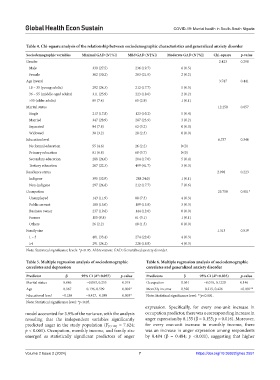
            Table 4. Chi‑square analysis of the relationship between sociodemographic characteristics and generalized anxiety disorder
            Sociodemographic variables  Minimal GAD (N [%])  Mild GAD (N [%])  Moderate GAD (N [%])  Chi‑square  p‑value
            Gender                                                                                 2.423  0.298
             Male                       330 (27.5)         236 (19.7)         6 (0.5)
             Female                     362 (30.2)         263 (21.9)         2 (0.2)
            Age (years)                                                                            3.747  0.441
             18 – 35 (young adults)     292 (24.3)         212 (17.7)         5 (0.5)
             36 – 55 (middle-aged adults)  311 (25.9)      223 (18.6)         2 (0.2)
             >55 (older adults)                  89 (7.4)            65 (2.9)  1 (0.1)
            Marital status                                                                    12.250   0.057
             Single                     213 (17.8)         123 (10.2)         5 (0.4)
             Married                    347 (28.9)         287 (23.9)         3 (0.2)
             Separated                           94 (7.8)            62 (5.2)  0 (0.0)
             Widowed                             38 (3.2)            28 (2.3)  0 (0.0)
            Education level                                                                       6.737  0.346
             No formal education                 55 (4.6)            26 (2.2)                  0 (0)
             Primary education                   81 (6.8)            68 (5.7)                  0 (0)
             Secondary education        288 (24.0)         204 (17.0)         5 (0.4)
             Tertiary education         267 (22.3)         499 (41.7)         3 (0.3)
            Residence status                                                                     2.998  0.223
             Indigene                   395 (32.9)         288 24.0)          1 (0.1)
             Non-indigene               297 (24.8)         212 (17.7)         7 (0.6)
            Occupation                                                                        25.750   0.001*
             Unemployed                 143 (11.9)               88 (7.3)     4 (0.3)
             Public servant             180 (15.0)         189 (15.8)         3 (0.3)
             Business owner             237 (19.8)         144 (12.0)         0 (0.0)
             Farmer                              105 (8.8)            61 (5.1)  1 (0.1)
             Others                              26 (2.2)            18 (1.5)  0 (0.0)
            Family size                                                                          1.313  0.519
             1 – 3                      401 (33.4)         274 (22.8)         4 (0.3)
             ≥4                         291 (24.2)         226 (18.8)         4 (0.3)
            Note: Statistical significance levels: *p<0.05. Abbreviation: GAD: Generalized anxiety disorder.

            Table 5. Multiple regression analysis of sociodemographic   Table 6. Multiple regression analysis of sociodemographic
            correlates and depression                          correlates and generalized anxiety disorder

            Predictor        β      95% CI (R =0.057)  p‑value  Predictors     β      95% CI (R =0.033)  p‑value
                                                                                             2
                                           2
            Marital status    0.086   −0.083, 0.255    0.319   Occupation     0.051     −0.018, 0.1220  0.146
            Age              0.367        0.136, 0.599  0.002*  Monthly income  0.320         0.215, 0.426  <0.001**
            Educational level  −0.258  −0.427, -0.089  0.003*  Note: Statistical significance level: **p<0.001.
            Note: Statistical significance level: *p<0.05.
                                                               expression. Specifically, for every one-unit increase in
            model accounted for 3.9% of the variance, with the analysis   occupation predictor, there was a corresponding increase in
            revealing that the independent variables significantly   anger expression by 0.155 (β = 0.155; p = 0.016). Moreover,
            predicted anger in the study population (F [7,1184] = 7.824;   for every one-unit increase in monthly income, there
            p < 0.001). Occupation, monthly income, and family size   was an increase in anger expression among respondents
            emerged as statistically  significant predictors of  anger   by 0.484 (β = 0.484;  p <0.001), suggesting that higher


            Volume 2 Issue 2 (2024)                         7                        https://doi.org/10.36922/ghes.2551

