


Page 122 - GHES-2-2
P. 122
Global Health Econ Sustain                                     COVID-19: Mental health in South-South Nigeria


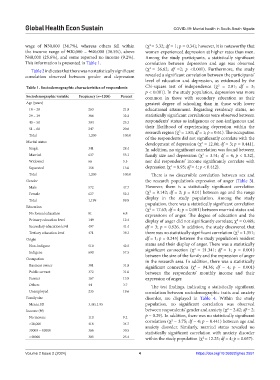
            wage of  ₦30,000  (34.7%), whereas  others fell  within   (χ = 3.32; df = 1; p = 0.34); however, it is noteworthy that
                                                                 2
            the income range of  ₦30,000 –  ₦40,000  (30.5%), above   women experienced depression at higher rates than men.
            ₦40,000 (25.6%), and some reported no income (9.2%).   Among the study participants, a statistically significant
            This information is presented in Table 1.          correlation between  depression  and age  was  observed
                                                                 2
              Table 2 indicates that there was no statistically significant   (χ =  36.62;  df =2;  p <0.001). Furthermore, the study
            correlation observed between gender and depression   revealed a significant correlation between the participants’
                                                               level of education and depression, as evidenced by the
                                                                                              2
            Table 1. Sociodemographic characteristics of respondents  Chi-square  test  of  independence  (χ   =  2.81;  df  =  3;
                                                               p < 0.001). In the study population, depression was more
            Sociodemographic variable  Frequency (n=1200)  Percent  common in those with secondary education as their
            Age (years)                                        greatest degree of schooling than in those with lower
             18 – 28                          263      21.8    educational attainment. Regarding residency status, no
             29 – 39                          386      32.2    statistically significant correlations were observed between
             40 – 50                          304      25.3    respondents’ status as indigenous or non-indigenous and
             51 – 60                          247      20.6    their likelihood of experiencing depression within the
                                                                             2
             Total                            1,200  100.0     research region (χ  = 1.83; df = 1; p = 0.61). The occupation
                                                               of the respondents did not significantly correlate with the
            Marital status                                     development of depression (χ  = 12.06; df = 3; p = 0.441).
                                                                                       2
             Single                           341      28.4    In addition, no significant correlation was found between
             Married                          637      53.1    family size and depression (χ  = 3.51; df = 4; p < 0.32),
                                                                                       2
             Widowed                          66       5.5     nor did respondents’ income significantly correlate with
                                                                          2
             Separated                        156      13.0    depression (χ  = 8.95; df = 4; p < 0.442).
             Total                            1,200  100.0       There is no discernible correlation between sex and
            Gender                                             the research population’s expression of anger (Table  3).
             Male                             572      47.7    However,  there is  a statistically  significant correlation
                                                                 2
             Female                           627      52.3    (χ  = 9.142; df = 2; p = 0.01) between age and the range
             Total                            1,199     99.9   display  in  the  study  population.  Among  the  study
                                                               population, there was a statistically significant correlation
            Education                                          (χ  = 17.63; df = 4; p = 0.001) between married status and
                                                                 2
             No formal education              81       6.8     expressions of anger. The degree of education and the
             Primary education level              149     12.4  display of anger did not significantly correlate; χ  = 0.468;
                                                                                                      2
             Secondary education level              497     41.4  df = 3; p = 0.926. In addition, the study discovered that
                                                                                                      2
             Tertiary education level              471     39.3  there was no statistically significant correlation (χ  = 1.351;
            Origin                                             df = 1; p = 0.245) between the study population’s resident
             Non-indigene                     510      42.5    status and their display of anger. There was a statistically
                                                                                    2
             Indigene                         690      57.5    significant connection (χ   = 21.341;  df  = 1;  p  = 0.001)
            Occupation                                         between the size of the family and the expression of anger
                                                               in the research area. In addition, there was a statistically
             Business owner                   381      31.8    significant connection (χ = 94.36;  df  = 4;  p = 0.001)
                                                                                    2
             Public servant                   372      31.0    between the respondents’ monthly income and their
             Farmer                           167      13.9    expression of anger.
             Others                           44       3.7       The test findings, indicating a statistically significant
             Unemployed                       235      19.6    correlation between sociodemographic traits and anxiety
            Family size                                        disorder, are displayed in  Table 4. Within the study
             Mean±SD                   3.48±1.95               population,  no  significant  correlation  was  observed
                                                                                                  2
            Income (₦)                                         between respondents’ gender and anxiety (χ  = 2.42; df = 2;
             No income                        110      9.2     p = 0.29). In addition, there was no statistically significant
                                                                          2
             <30,000                          416      34.7    correlation (χ  = 3.75; df = 4; p = 0.441) between age and
                                                               anxiety disorder. Similarly, married status revealed no
             30000 – 40000                    366      30.5    statistically significant correlation with anxiety disorder
             >40000                           305      25.4    within the study population (χ = 12.25; df = 4; p = 0.057).
                                                                                       2

            Volume 2 Issue 2 (2024)                         4                        https://doi.org/10.36922/ghes.2551

