


Page 88 - GHES-2-2
P. 88
Global Health Econ Sustain                                         HCWs and violence in emergency services


            about the health of their patients. These tensions can lead   3. Results
            to disruptive actions such as damaging property, verbally
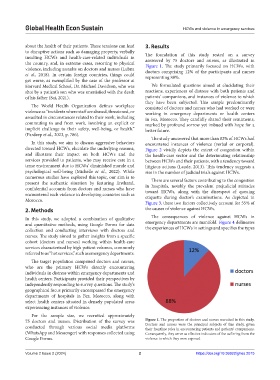
            insulting  HCWs  and  health-care-related  individuals  in   The foundation of this study rested on a survey
            the country, and, in extreme cases, resorting to physical   answered by 75 doctors and nurses, as illustrated in
            violence, including assaults on doctors and nurses (Lubna   Figure  1. The study primarily focused on HCWs, with
                                                               doctors comprising 12% of the participants and nurses
            et al., 2018). In certain foreign countries, things could   representing 88%.
            get worse, as exemplified by the case of the professor at
            Harvard Medical School, Dr. Michael Davidson, who was   We formulated questions aimed at elucidating their
            shot by a patient’s son who was unsatisfied with the death   reactions, experiences of distress with both patients and
            of his father (Sai, 2021).                         patients’ companions, and instances of violence to which
                                                               they have been subjected. This sample predominantly
              The  World  Health  Organization  defines  workplace   consisted of doctors and nurses who had worked or were
            violence as “incidents where staff are abused, threatened, or   working in emergency departments or health centers
            assaulted in circumstances related to their work, including   in Fez, Morocco. They candidly shared their sentiments,
            commuting to and from work, involving an explicit or   marked by profound sorrow yet imbued with hope for a
            implicit challenge to their safety, well-being, or health.”   better future.
            (Pardeep et al., 2023, p. 786).
                                                                 The study uncovered that more than 82% of HCWs had
              In this study, we aim to discuss aggressive behaviors   encountered instances of violence (verbal or corporal).
            directed toward HCWs, elucidate the underlying reasons,   Figure  2  vividly depicts the extent of congestion within
            and illustrate their impact on both HCWs and the   the  health-care  sector  and the  deteriorating relationship
            services provided to patients, who may receive care in a   between HCWs and their patients, with a tendency toward
            tense environment due to HCWs’ diminished morale and   litigious actions (Laude, 2013). This tendency suggests a
            psychological  well-being  (Michelle  et al.,  2022).  While   rise in the number of judicial trials against HCWs.
            numerous studies have explored this topic, our aim is to
            present the authentic situation by featuring firsthand,   There are several factors contributing to the congestion
            confidential accounts from doctors and nurses who have   in hospitals, notably the prevalent prejudicial attitudes
            encountered such violence in developing countries such as   toward HCWs, along with the disrespect of queuing
                                                               etiquette during doctor’s examinations. As depicted in
            Morocco.
                                                               Figure 3, these two factors collectively account for 55% of
            2. Methods                                         the causes of violence against HCWs.
            In  this study, we adopted a combination of qualitative   The consequences of violence against HCWs in
            and quantitative methods, using Google Forms for data   emergency departments are manifold. Figure 4 delineates
            collection and conducting interviews with doctors and   the experiences of HCWs in settings and specifies the types
            nurses. The study aimed to gather insights from a specific
            cohort (doctors and nurses) working within health-care
            services characterized by high patient volumes, commonly
            referred to as “hot services,” such as emergency departments.

              The target population comprised doctors and nurses,
            who  are the primary HCWs directly  encountering
            individuals in distress within emergency departments and
            health centers. Participants provided their perspectives by
            independently responding to survey questions. The study’s
            geographical focus primarily encompassed the emergency
            departments of hospitals in Fez, Morocco, along with
            select health centers situated in densely populated areas
            experiencing instances of violence.
              For the sample size, we recruited approximately
            75 doctors and nurses. Distribution of the survey was   Figure 1. The proportion of doctors and nurses recruited in this study.
            conducted  through  various  social  media  platforms   Doctors and nurses were the principal subjects of this study, given
                                                               their frontline roles in encountering patients and patients’ companions.
            (WhatsApp and Messenger) with responses collected using   Consequently, they serve as effective indicators of the suffering from the
            Google Forms.                                      violence to which they were exposed.


            Volume 2 Issue 2 (2024)                         2                        https://doi.org/10.36922/ghes.2015

