


Page 90 - GHES-2-2
P. 90
Global Health Econ Sustain                                         HCWs and violence in emergency services


                                                               measures should be implemented by the Ministry of
                                                               Health, the Ministry of Justice (attorney), the judicial
                                                               police, and especially mainstream media outlets.

                                                               4.1. The prejudgment: An attitude rooted in minds
                                                               Prejudgment stands as one of the most significant
                                                               challenges HCWs are facing in contemporary health
                                                               centers and hospitals. It represents an enduring stereotype
                                                               deeply entrenched in the minds and perceptions of the
                                                               public, persisting despite the efforts deployed by young
                                                               doctors and nurses to combat it.
                                                                 The prevailing issue lies in the belief held by citizens
                                                               that  they will  not receive adequate services  at  hospitals
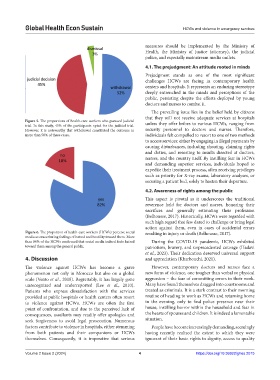
            Figure 5. The proportions of health-care workers who pursued judicial   unless they offer bribes to various HCWs, ranging from
            trial. In this study, 45% of the participants opted for the judicial trial.
            However, it is noteworthy that withdrawal constituted the outcome in   security personnel to doctors and nurses. Therefore,
            more than 50% of these cases.                      individuals felt compelled to resort to one of two methods
                                                               to access services: either by engaging in illegal payments by
                                                               causing disturbances, including shouting, claiming rights
                                                               and duties, and resorting to insults directed at doctors,
                                                               nurses, and the country itself. By instilling fear in HCWs
                                                               and demanding superior services, individuals hoped to
                                                               expedite their treatment process, often receiving privileges
                                                               such as priority for X-ray exams, laboratory analyses, or
                                                               securing a patient bed, solely to hasten their departure.

                                                               4.2. Awareness of rights among the public
                                                               This aspect is pivotal as it underscores the traditional
                                                               reverence held for doctors and nurses, honoring their
                                                               sacrifices and generally estimating their profession
                                                               (Belhousse, 2017). Historically, HCWs were regarded with
                                                               such high regard that few dared to challenge or bring legal
                                                               action against them, even in cases of accidental errors
            Figure 6. The proportion of health-care workers (HCWs) perceive social   resulting in injury or death (Belhousse, 2017).
            media as exacerbating feelings of hatred and hostility toward them. More
            than 80% of the HCWs confirmed that social media indeed fuels hatred   During the COVID-19 pandemic, HCWs exhibited
            toward them among the general public.              patriotism, bravery, and unprecedented courage (Hadavi
                                                               et al., 2023). Their dedication deserved universal support
            4. Discussion                                      and appreciation (Kharbouchi, 2021).
            The violence against HCWs has become a grave         However,  contemporary doctors and  nurses  face  a
            phenomenon not only in Morocco but also on a global   new form of violence, one tougher than verbal or physical
            scale (Vento et al., 2018). Regrettably, it has largely gone   aggression – the fear of committing errors in their work.
            unrecognized and underreported (Lee  et al., 2010).   Many have found themselves dragged into courtrooms and
            Patients who express dissatisfaction with the services   treated as criminals. It is a stark contrast to their morning
            provided at public hospitals or health centers often resort   routine of heading to work as HCWs and returning home
            to violence against HCWs. HCWs are often the first   in the evening, only to find police presence near their
            point of confrontation, and due to the perceived lack of   house, instilling horror within the household and fear in
            consequences, assailants may readily offer apologies and   the hearts of spouses and children. It is indeed a lamentable
            seek forgiveness to avoid legal prosecution. Numerous   situation.
            factors contribute to violence in hospitals, either stemming   People have become increasingly demanding, seemingly
            from both patients and their companions or HCWs    having recently realized the extent to which they were
            themselves. Consequently,  it is  imperative that  serious   ignorant of their basic rights to dignity, access to quality


            Volume 2 Issue 2 (2024)                         4                        https://doi.org/10.36922/ghes.2015

