


Page 92 - GHES-2-2
P. 92
Global Health Econ Sustain                                         HCWs and violence in emergency services


            grants public administrations the authority to protect   initiative aims to counter negative perceptions and
            their staff against threats, attacks, outrages, insults, or   prejudices held by the public toward HCWs and
            defamation while on duty.                             public hospitals, which often lead to hostile attitudes
              Unfortunately,  despite  these  legal  provisions,  a   and behaviors.
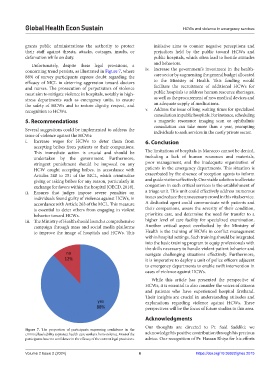
            concerning trend persists, as illustrated in Figure 7, where   iv.  Increase the government’s investment in the health-
            88%  of  survey  participants  express  doubt  regarding  the   care sector by augmenting the general budget allocated
            efficacy of MCL in deterring aggression toward doctors   to the Ministry of Health. This funding would
            and nurses. The prosecution of perpetrators of violence   facilitate the recruitment of additional HCWs for
            must aim to mitigate violence in hospitals, notably in high-  public hospitals to address human resource shortages,
            stress departments such as emergency units, to ensure   as well as the procurement of new medical devices and
            the safety of HCWs and to restore dignity, respect, and   an adequate supply of medications.
            recognition to HCWs.                               v.  Address the issue of long waiting times for specialized
                                                                  consultation in public hospitals. For instance, scheduling
            5. Recommendations                                    a  magnetic  resonance  imaging  scan  or  ophthalmic
                                                                  consultation can take more than a year, prompting
            Several suggestions could be implemented to address the   individuals to seek services in the costly private sector.
            issue of violence against the HCWs:
            i.   Increase  wages for HCWs to deter them from   6. Conclusion
               accepting bribes from patients or their companions.
               This immediate action is crucial and should be   The limitations of hospitals in Morocco cannot be denied,
               undertaken by the government. Furthermore,      including a lack of human resources and materials,
               stringent punishment should be imposed on any   poor management, and the inadequate organization of
               HCW caught accepting bribes, in accordance with   patients in the emergency departments. This situation is
               Articles 248 to 251 of the MCL, which criminalize   exacerbated by the absence of reception agents to inform
               giving or taking bribes for any reason, particularly in   and guide visitors effectively. One viable solution to alleviate
               exchange for favors within the hospital (OECD, 2018).  congestion in such critical services is the establishment of
            ii.  Ensures that judges impose severe penalties on   a triage unit. This unit could effectively address numerous
               individuals found guilty of violence against HCWs, in   issues and reduce the unnecessary crowd in this vital service.
               accordance with Article 263 of the MCL. This measure   A dedicated agent could communicate with patients and
               is essential to deter others from engaging in violent   their companions, assess the severity of their condition,
               behavior toward HCWs.                           prioritize care, and determine the need for transfer to a
            iii.  The Ministry of Health should launch a comprehensive   higher  level  of  care  facility  for  specialized  examination.
               campaign through mass and social media platforms   Another critical aspect overlooked by the Ministry of
               to improve the image of hospitals and HCWs. This   Health is the training of HCWs in conflict management
                                                               within hospital settings. Such training should be integrated
                                                               into the basic training program to equip professionals with
                                                               the skills necessary to handle violent patient behavior and
                                                               navigate challenging situations effectively. Furthermore,
                                                               it is imperative to deploy a unit of police officers adjacent
                                                               to emergency departments to enable swift intervention in
                                                               cases of violence against HCWs.

                                                                 While this article has presented the perspective of
                                                               HCWs, it is essential to also consider the voices of citizens
                                                               and patients who have experienced hospital firsthand.
                                                               Their insights are crucial in understanding attitudes and
                                                               explanations regarding violence against HCWs. These
                                                               perspectives will be the focus of future studies in this area.

                                                               Acknowledgments
                                                               Our thoughts are directed to Pr. Said Saddiki; we
            Figure  7. The proportion of participants expressing confidence in the
            criminal law’s ability to protect health-care workers from violence. Most of the   acknowledge his positive contribution through his precious
            participants have no confidence in the efficacy of the current legal provisions.  advice. Our recognition of Pr. Hassan Rhiya for his efforts


            Volume 2 Issue 2 (2024)                         6                        https://doi.org/10.36922/ghes.2015

